
A slitting machine is a kind of mechanical equipment commonly used in industrial production to cut objects into multiple small pieces or slender strips. Its working principle mainly includes three steps: positioning, cutting and discharge.
The slitting machine needs to position the object to be cut. This is usually achieved through sensors or cameras. Sensors can detect the position and size of an object to determine where and how to cut. Cameras monitor the position and shape of objects in real time and transmit this information to the control system. Based on the received data, the control system accurately calculates the cutting position and cutting method.
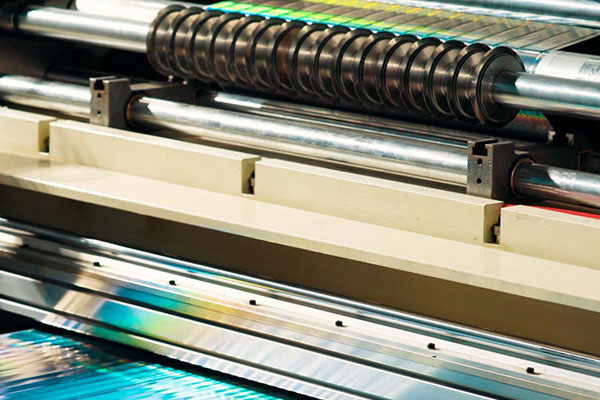
Next, the slitter machine cuts based on the results of the positioning. There are usually two types of cutting: knife cutting and laser cutting. Knife cutting is the cutting of objects by means of knives mounted on a slitter. The knives can be disc knives, blades, or die cutters, etc. The principle of knife cutting is to cut an object through the high-speed rotation or movement of the knife. Laser cutting uses a laser beam to cut objects with high precision. The laser beam can be transmitted to the cutting point by specular reflection or optical fiber, which enables the cutting.
The slitting machine will expel the cut object. The way of discharge is usually by means of a conveyor belt or a robotic arm to move the cut object to the designated position. The conveyor belt can move the object at a certain speed and direction, so that it can be discharged smoothly. The robotic arm can grasp, move and place the object as needed to achieve the function of discharge.
In addition to the above basic working principles, the slitting machine can also carry out some special treatment according to specific needs. For example, coolant can be added during the cutting process to reduce the cutting temperature and avoid deformation or damage to the object. The cutting speed and force can also be adjusted according to the hardness and material of the object to achieve the best cutting effect.
To sum up, the working principle of the slitting machine includes three steps: positioning, cutting, and discharge. Through precise positioning, suitable cutting methods and efficient discharge methods, the slitter machine can achieve fast, accurate and continuous cutting of objects. It is widely used in industrial production and can be used for cutting various materials such as paper, plastic, metal, etc., which greatly improves production efficiency and quality.
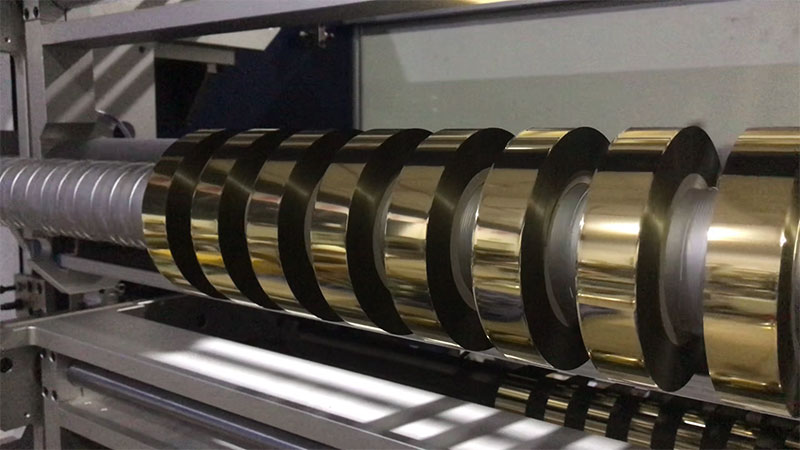
The tension control in the slitting stage directly determines the yield rate of subsequent hot stamping processes.
28. September, 2026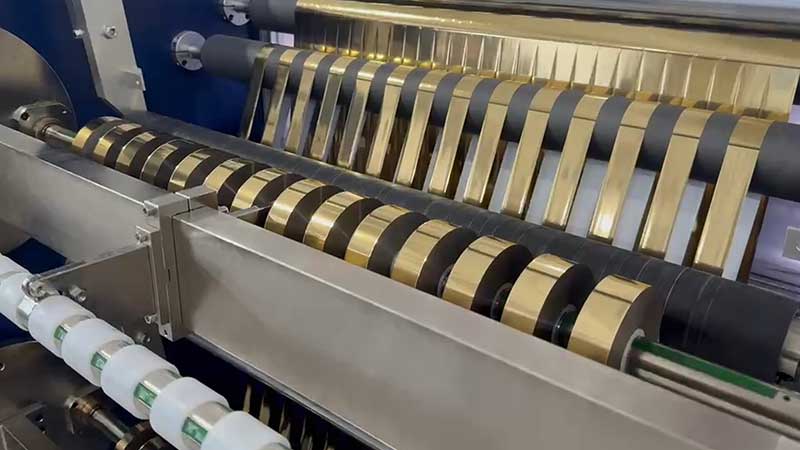
The key to selection is to grasp three parameters that truly determine slitting quality: slitting accuracy, tension control, and tool system.
28. September, 2026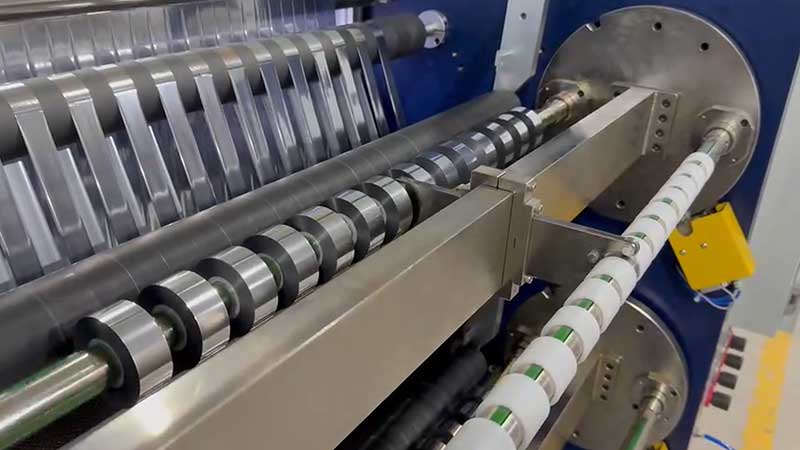
But what truly determines whether a slitting machine is "in sync" is not the absolute value of a single parameter, but the matching logic between width and speed.
28. September, 2026Width determines the rigidity and correction accuracy of the equipment's structure, while speed tests the real-time responsiveness of tension control.
24. September, 2026This article provides a current selection framework from four dimensions: material adaptation, core parameters, intelligent configuration, and cost evaluation.
24. September, 2026


 English
 Deutsch
 Français
 Español
 Português
 日本語
日本語 русский
 한국어
한국어 عربي
عربي ภาษาไทย
 Tiếng Việt
 Italiano