
The slitting accuracy of the slitting and rewinding machine is the key factor affecting the product quality, and its accuracy guarantee involves many aspects such as mechanical design, process control, operation and maintenance. The following are the main measures to ensure the slitting accuracy:
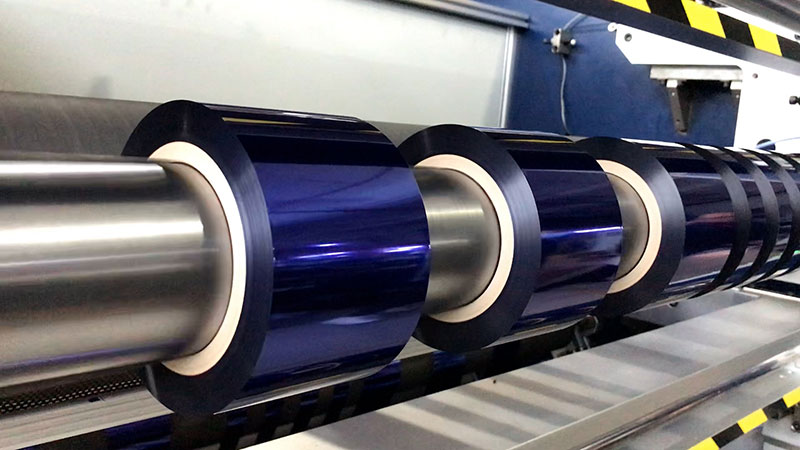
1. Mechanical structure and design
• High-precision tooling system:
◦ Round knives or razors coated with carbide or diamond to ensure a sharp, wear-resistant edge.
◦ The radial runout of the tool should be controlled within ±0.005mm to avoid burrs or deviations caused by vibration.
◦ Dynamic balance correction of the tool shaft to reduce vibration during high-speed operation.
• Stable tension control system:
◦ Use closed-loop tension control (e.g., magnetic particle brake, servo motor + tension sensor) to ensure that the tension of the material is constant (usually within ±1%) during the slitting process.
◦ Segmented tension control (unwinding, traction, rewinding) to avoid stretching or wrinkling of the material.
• Guidance & Guiding Systems:
◦ Equipped with automatic deviation correction device (EPC or CCD vision system), real-time detection of material edge position, deviation correction accuracy up to ±0.1mm.
◦ Use high-straightness guide rollers to ensure a stable material trajectory.
2. Optimization of process parameters
• Slitting speed matching:
◦ Adjust the speed according to the material characteristics (e.g., film, paper, nonwoven) to avoid inertial drift due to high speed.
◦ Thick/hard materials need to reduce the speed, and thin/soft materials can increase the speed appropriately.
• Tool configuration and angle:
◦ The tool clearance needs to be adjusted according to the thickness of the material (for example, the film is usually 10%~20% of the thickness of the material).
◦ The amount of tool overlap (for shear slitting) needs to be precisely controlled to avoid pulling or cutting the material.
• Winding pressure control:
◦ Constant pressure winding or taper winding is used to prevent cross-layering caused by loose inside and tight inside and outside of the coil.
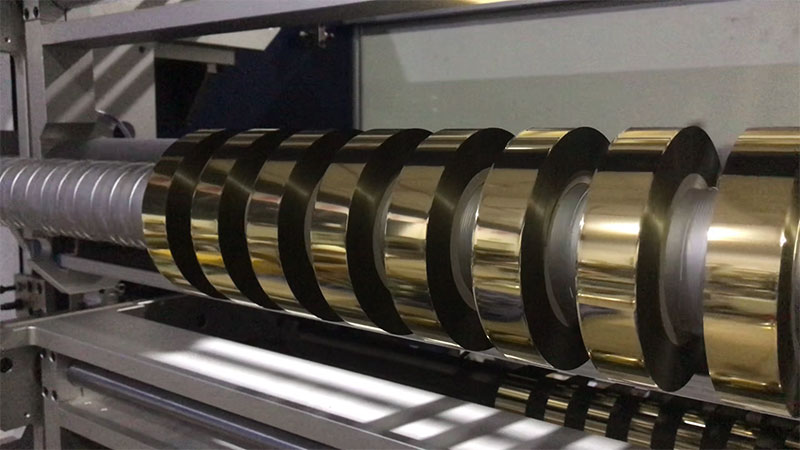
3. Automation and inspection technology
• On-line monitoring system:
◦ Laser width gauge or camera monitors the slitting width in real time, and automatically alarms or adjusts when the deviation exceeds the limit.
◦ Surface defect detection (e.g., scratches, foreign matter) to prevent defective products from entering the subsequent process.
• Numerical Control System:
◦ PLC or CNC control slitting parameters (such as length, speed, tension), repeat positioning accuracy up to ±0.1mm.
◦ Preset process recipe to reduce human error.
4. Operation and maintenance
• Scheduled Maintenance:
◦ Check the wear and tear of the tool every 8 hours, and replace or grind it in time.
◦ Clean the guide rollers and sensors to prevent dust from affecting accuracy.
◦ Lubricate bearings and guides to reduce mechanical friction.
• Operational Specifications:
◦ Calibrate the tool and guiding system before start-up.
◦ The first article must be inspected (width, burr, roll uniformity), and mass production will be carried out after qualification.
◦ Avoid misalignment of materials or sudden changes in tension.
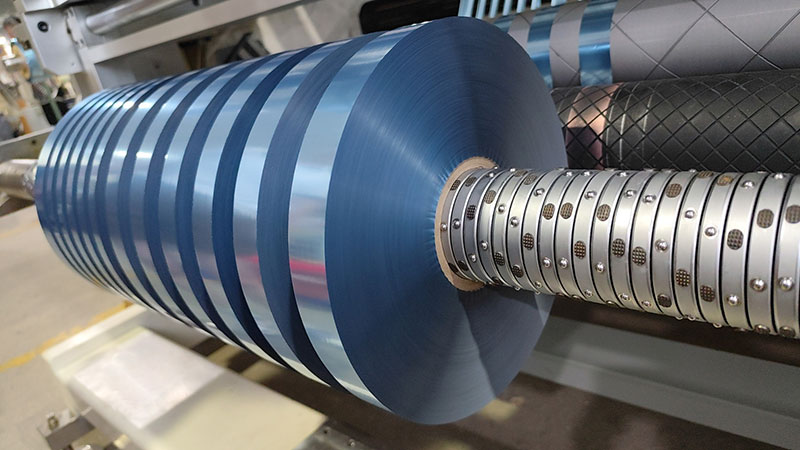
5. Materials and environmental factors
• Material Pretreatment:
◦ Before slitting, make sure that the material is static-free, wrinkle-free, and has the right humidity (especially for paper and film).
•Environmental control:
◦ Stable temperature and humidity (e.g., ±2°C, 50%±5%RH) to prevent thermal expansion and contraction of materials.
Common problems and solutions
• Trimming burrs: Check for tool wear or excessive clearance.
• Width deviations: Calibrate the guiding system or check for tension fluctuations.
• Roll end face is not aligned: Adjust the winding pressure or guiding sensitivity.
Through the above comprehensive measures, the slitting accuracy of modern slitting and rewinding machine can reach ±0.1mm (high-end models can reach ±0.05mm), which can meet the needs of precision packaging, electronic film and other industries. The key is to dynamically adjust parameters based on material properties and production requirements, and to maintain equipment stability.
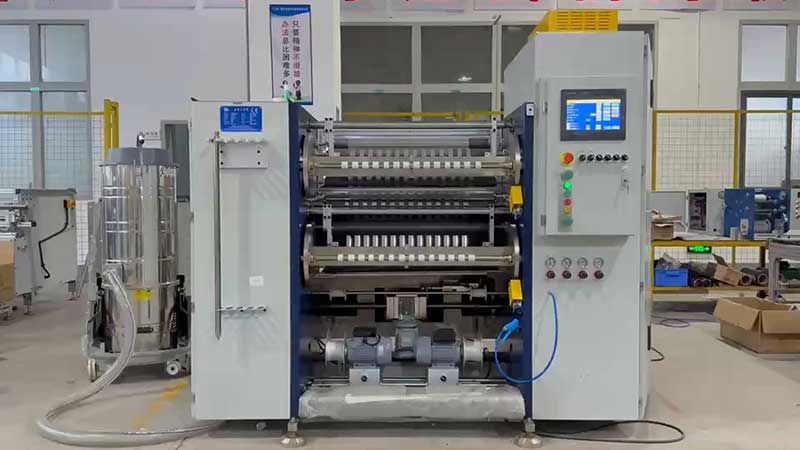
Whether you operate a slitting line or source slit rolls from a supplier, understanding these failure modes helps you protect quality and reduce downtime.
08. October, 2026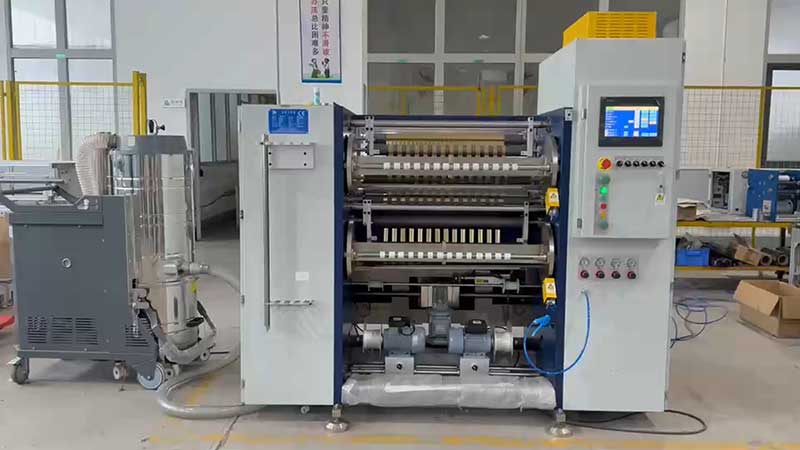
This guide breaks down the specifications that actually matter, organized by the parameters that directly affect your yield, efficiency, and bottom line.
08. October, 2026
The essence of uneven end faces in ribbon slitting machines is an external manifestation of subtle imbalances between tension, parallelism, correction, and tool condition.
05. October, 2026
To solve this problem, a systematic inspection is needed from four dimensions: tension control, mechanical precision, auxiliary systems, and operating standards.
05. October, 2026The tension control in the slitting stage directly determines the yield rate of subsequent hot stamping processes.
28. September, 2026


 English
 Deutsch
 Français
 Español
 Português
 日本語
日本語 русский
 한국어
한국어 عربي
عربي ภาษาไทย
 Tiếng Việt
 Italiano