
In the printing and packaging industry, the hot stamping process has always been the "touchstone" to enhance the added value of products. However, behind this brilliant effect, the prepress slitting process has long hidden a nightmare that keeps countless factory directors and captains awake at night - slitting folds.
Have you ever been in such a situation?
• Expensive imported hot stamping foil, as soon as it is pulled on the machine, fine "dead folds" immediately appear on the edges, and the whole roll of material is instantly scrapped.
• The delivery time is imminent, but due to the uneven slitting end face, the foil is unstable during hot stamping, and the scrap rate soars.
• Looking at the curly foil tape in the warehouse due to the unreleased slitting stress, I can only sigh helplessly.
Folds, this seemingly small flaw, cut off not only the material, but also the profit and reputation of the enterprise.
Could it be that in the field of hot stamping foil slitting, is it really impossible to have both precision and flatness? Today, the device we are going to introduce may give an almost perfect answer.
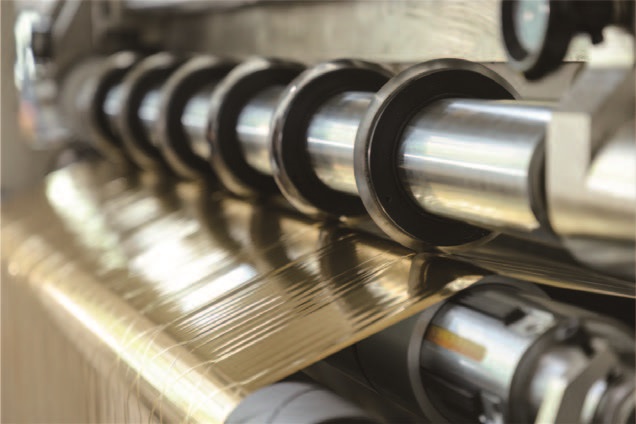
Pain point hit: Why does the traditional slitting machine always "shake"?
Traditional slitting machines often face three "dead ends" when processing hot stamping foil:
1. Tension Out of Control: The foil foil substrate is as thin as a cicada's wings and is extremely sensitive to tension. The tension fluctuations of traditional equipment, like dancing on a steel wire, can cause the material to stretch and deform, forming folds.
2. Insufficient shaft system accuracy: Under high-speed operation, even a slight radial runout will be converted into microscopic vibration at the edge of the foil belt. This high-frequency vibration is amplified layer by layer as it is rewound, eventually forming an "daisy core" or "skirt" that cannot be eliminated.
3. Static Electricity and Dust: The static electricity generated by slitting adsorbs dust, leading to uneven foil surfaces and further exacerbating the formation of wrinkles.
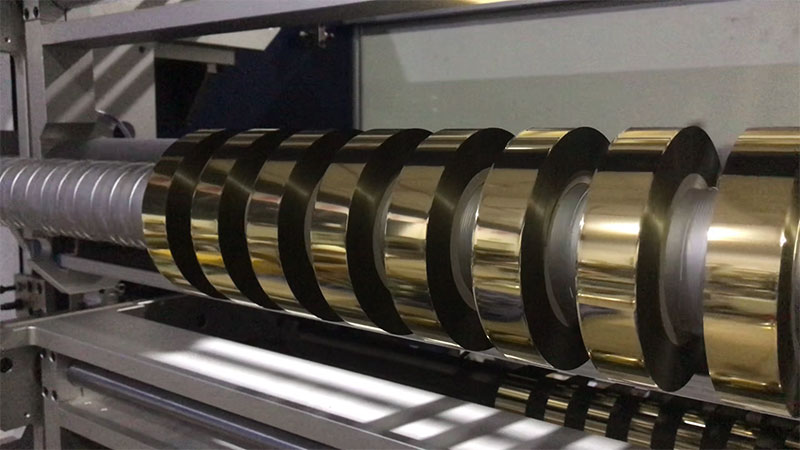
Solution: Use rock-like technology to say goodbye to folds
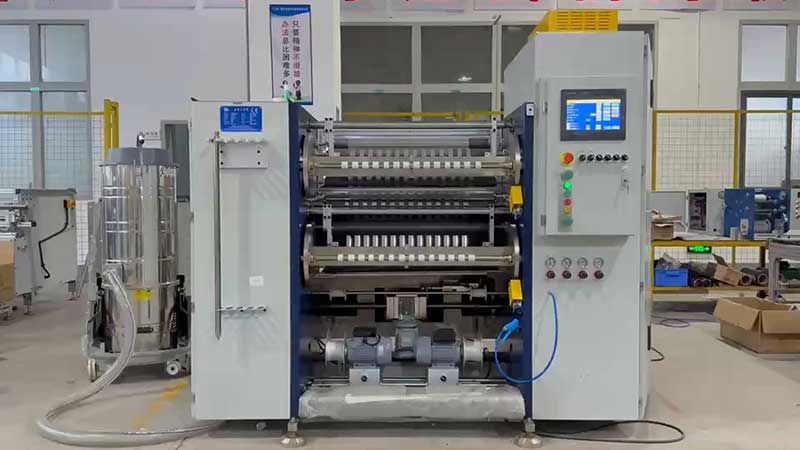
In order to completely overcome this stubborn disease in the industry, the R&D team of Delishi went deep into the front line, and after countless structural optimizations and actual measurements, launched this special slitting machine for hot stamping foil with the word "stable". The reason why it can say goodbye to wrinkles relies on the "three major sea god needles":
1. Servo closed-loop tension system: put on "soft hedgehog armor" for materials
We use a fully digital servo motor with imported tension sensor to achieve millisecond-level response. Whether starting, accelerating or braking, tension fluctuations are controlled within a very small range of ±0.5N. It is like an experienced veteran, regardless of the thickness of the material, it can feed "gently and firmly", eliminating longitudinal folds caused by pulling.
2. Military-grade tough fuselage: "silent high-speed rail" in slitting
The overall casting of the fuselage has been aged, the core spindle adopts mirror level grinding process, and the dynamic balance calibration has reached G0.4 (the highest precision level). At operating speeds of up to 300 m/min, the machine remains as stable as Mount Tai, with almost no vibration transmitted to the tool shaft. This means that the contact between the blade and the material is "one-off" and clean, completely cutting off the source of the lateral folds caused by microscopic vibrations.
3. Independent edge waste treatment: coiled flat like a mirror
We have redesigned the waste discharge path of the waste edge strip, using an independent fan to absorb waste to avoid interference with the main material caused by the edge pulling. The winding adopts the central surface winding technology, with the pressing roller smoothing, to ensure that the end surface of each meter of hot stamping foil is as flat as a knife after leaving the machine, providing a perfect "runway" for subsequent high-temperature and high-pressure hot stamping.
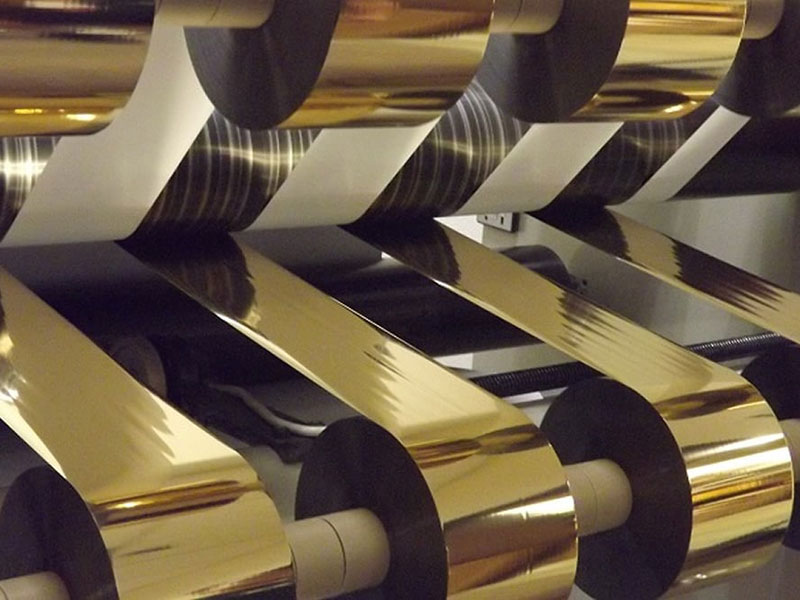
Customer testimonials: from "not daring to cut" to "bold hoarding"
"In the past, we didn't dare to cut the imported gold leaf ourselves, so we could only let the supplier cut it and send it over, which was not only expensive, but also subject to others." Li Gong, production director from a well-known cigarette pack company, shared, "Since getting on this machine, we have not only achieved independent slitting of all gold leaf, but more importantly, there have been no hot stamping downtime accidents caused by slitting folds." It is really stable, stable enough that we dare to stock up on a large number of wide plain foils in the peak season, and cut them as we go, reducing inventory costs by 30%. ”
Conclusion: Stability is the highest level of cost reduction and efficiency increase
Today, when the hot stamping process is increasingly pursuing the ultimate, the "stability" of the slitting link is the "protection" of profits.
Say goodbye to slitting folds, not only to waste, but also to the anxiety and uncertainty in the production process. If you also want your hot stamping workshop to have a trustworthy "steady general", you might as well learn about this slitting equipment that really understands hot stamping foil.
because it is professional, it is stable; Because it is stable, it is trustworthy.
Whether you operate a slitting line or source slit rolls from a supplier, understanding these failure modes helps you protect quality and reduce downtime.
08. October, 2026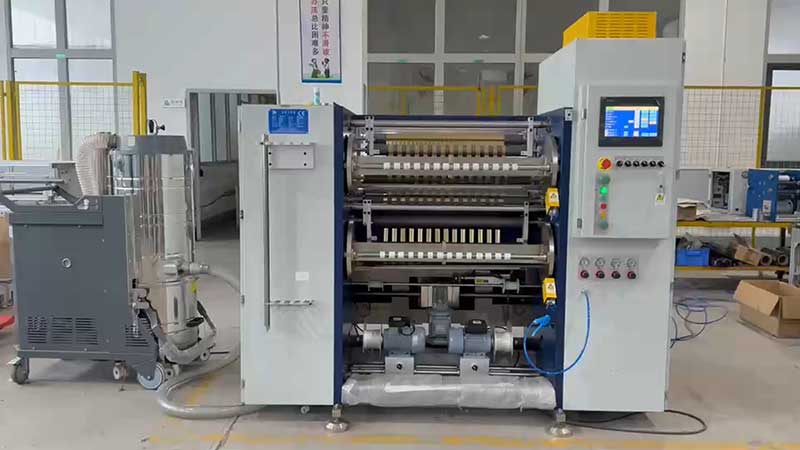
This guide breaks down the specifications that actually matter, organized by the parameters that directly affect your yield, efficiency, and bottom line.
08. October, 2026The tension control in the slitting stage directly determines the yield rate of subsequent hot stamping processes.
28. September, 2026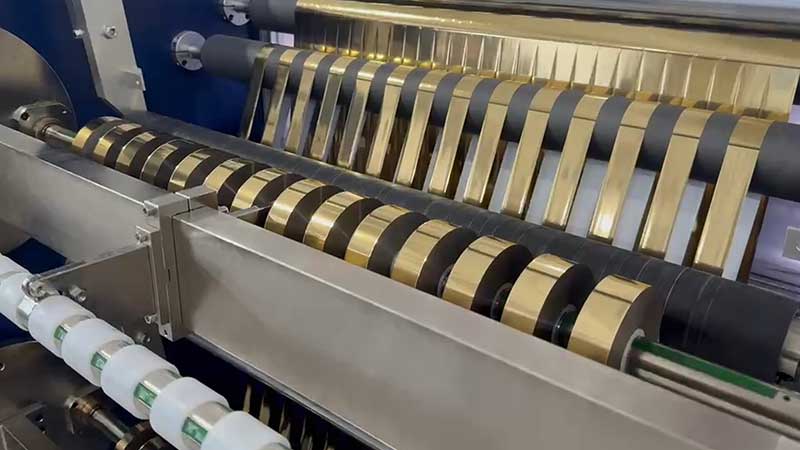
The key to selection is to grasp three parameters that truly determine slitting quality: slitting accuracy, tension control, and tool system.
28. September, 2026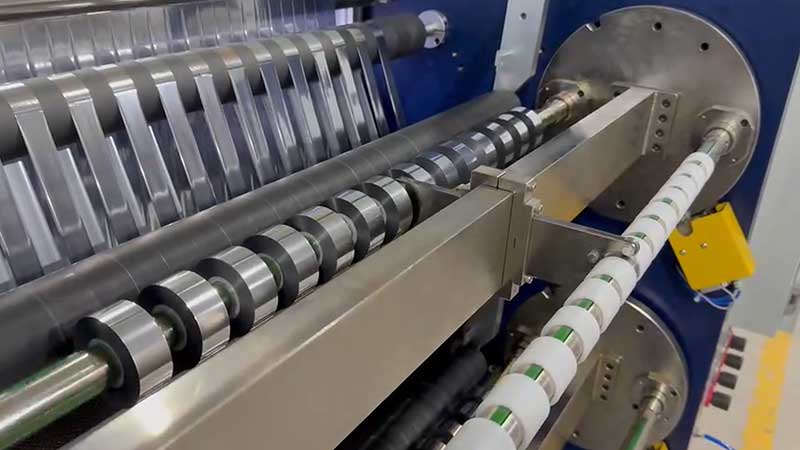
But what truly determines whether a slitting machine is "in sync" is not the absolute value of a single parameter, but the matching logic between width and speed.
28. September, 2026


 English
 Deutsch
 Français
 Español
 Português
 日本語
日本語 русский
 한국어
한국어 عربي
عربي ภาษาไทย
 Tiếng Việt
 Italiano