
In hot stamping foil production, winding and wrinkling after slitting are common quality defects, directly affecting yield and production efficiency. The essence of wrinkling is that the foil surface causes uneven slippage or extrusion deformation during the winding process. To solve this problem, it is usually necessary to start from two dimensions: roller state and tension control.
Analysis of wrinkle causes
The thickness of the hot stamping foil is only 12–30 μm, and the surface is coated with a release layer and an adhesive layer, which is extremely sensitive to tension and contact pressure. There are three main types of causes of winding and wrinkling:
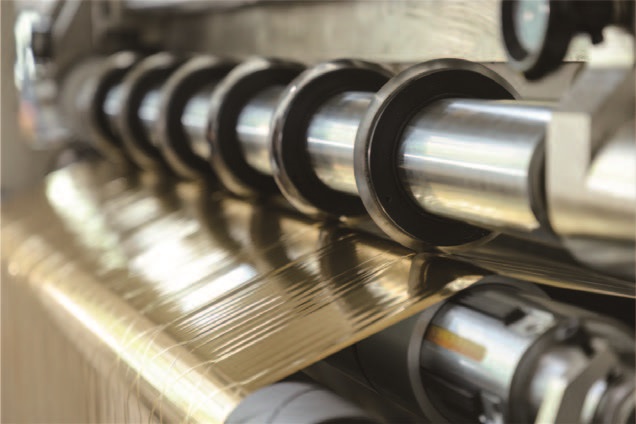
• Roller Factors: Uneven surface hardness, non-parallel axis or rubber aging lead to uneven lateral pressure distribution on the foil surface, resulting in micro-folds and amplification layer by layer.
• Improper tension curve: The taper tension curve is set unreasonably, and the tension of the outer layer of the winding layer is too large or the tension of the inner layer is insufficient, resulting in slippage and wrinkling between layers.
• Mechanical vibration and guide roller deflection: During high-speed slitting, the vibration of the equipment causes the foil surface to instantly relax, superimposing the unstable pressure roller contact force, causing random wrinkles.
Adjustment method of the pressure roller
The press roller is used to press the hot stamping foil against the winding core, expelling the air between the layers and providing frictional traction. The key points of adjustment are as follows:
1. Check the parallelism of the press roller: Use a feeler gauge or laser centering instrument to ensure that the axis of the roller is parallel to the axis of the winding shaft, and the left and right pressure deviation is controlled within 0.05mm/m. The non-parallelism will cause the foil surface to be tight on one side and loose on the other side, and the loose side is easy to wrinkle.
2. Optimize the hardness and adhesion of the roller: The hot stamping foil should be made of polyurethane or nitrile rubber rollers with a hardness of HS 60–75, and the surface should be ground to Ra 0.8–1.6μm. Overly hard rollers cannot adapt to fluctuations in foil thickness, and too soft rollers are prone to deformation and uneven pressure.
3. Adjust the pressure and lifting timing of the roller: reduce the pressure of the roller to the minimum value that just eliminates the air between the layers (usually the line pressure is 10–30 N/cm). At the same time, the roller is set to contact the core before the winding start, and lift it when it stops to avoid wrinkles formed by instantaneous impact.
4. Floating roller mechanism: For high-end slitting machines, a floating roller that automatically adjusts the position with the change of roll diameter can be installed to always maintain a constant wrapping angle and contact pressure, greatly reducing the probability of wrinkling.
Optimization strategy of tension curve
The tension curve refers to the law that the winding tension changes with the increase of the coil diameter. The most commonly used taper tension control for hot stamping foil is:
• Taper coefficient selection: The typical initial tension is 8%–12% of the material breaking tension, and the end tension is 40%–70% of the initial tension. The taper coefficient K is generally 0.5–0.8. If the coefficient is too small, the outer layer tension is too large, and the inner layer will be squeezed to produce chrysanthemum core-like folds; if the coefficient is too large, the inner layer will relax and cause collapse and wrinkling.
• Segmented tension control: A more advanced solution is to divide the winding process into starting section (0–20% coil diameter), constant tension section (20%–70% coil diameter), and taper descending section (70%–100% coil diameter). The starting section uses lower tension to ensure the flatness of the core; the constant tension section maintains a stable interlayer pressure; the taper descending section gradually reduces the tension to compensate for the weight of the outer ring.
• Combined with roller pressure linkage adjustment: In high-end slitting machines, the roller pressure is coupled with the winding tension in proportion. When the tension taper decreases, the pressure of the roller is reduced synchronously to avoid the contradictory state of "small outer tension and high pressure of the roller", which is the common cause of wrinkling of the foil.
Practical Cases and Verification
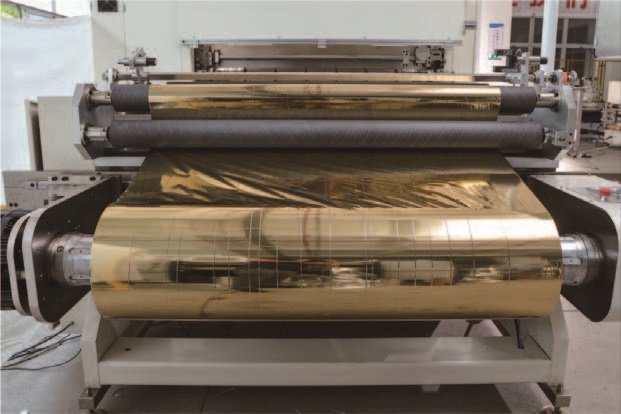
A hot stamping foil enterprise slitted 12μm PET-based hot stamping foil, and longitudinal dead folds frequently appeared when the winding diameter was 400mm. After testing, it was found that the pressure difference between the left and right sides of the pressure roller reached 18N (set to 60N), and the tension curve was constant tension mode (200N constant).
Adjustment steps:
1. Re-correct the parallelism of the roller, and adjust the left and right pressure to 60±3N;
2. Change the tension curve to taper control: the initial tension is 180N, the taper coefficient is 0.65, and the termination tension is about 70N;
3. The pressure of the roller decreases linearly from 50N to 20N with the diameter of the roll.
After adjustment, 10 rolls are continuously produced, each roll has a length of 6000m, the wrinkling rate is reduced from 12.7% to less than 0.8%, the winding end face is neat, and the flatness of the foil surface meets the requirements of hot stamping.
Quick Troubleshooting List
When a wrinkling occurs, it can be quickly located in the following order:
| Characteristics of the phenomenon | Priority inspection items |
| Only the core is wrinkled | The starting tension is too large or the pressure roller is in early contact |
| Only the outer ring is wrinkled | Small taper coefficient (too much outer tension) |
| The whole volume is wrinkled randomly | The hardness of the pressure roller is uneven or the guide roller is not parallel |
| Periodic wrinkles | The roller is eccentric or the rewinding shaft vibrates |
| Wrinkled on one side | The parallelism of the pressure roller is excessive |
Epilogue
The slitting and wrinkling of hot stamping foil is essentially the result of the mismatch between the mechanical constraint (roller) and the mechanical boundary (tension curve). Priority is given to calibrating the parallelism and surface state of the roller, and then designing a reasonable taper tension curve based on the characteristics of the foil, and introducing linkage control of roller pressure and tension if necessary. Through the fine adjustment of these two core parameters, most of the winding and wrinkling problems can be effectively solved, thereby improving the slitting quality and production efficiency of foil stamping.
A mature automated system needs to form a closed loop simultaneously across four dimensions: correction, tension, cutting, and data management.
21. October, 2026The value of customized slitting solutions lies in turning "cutting accurately, changing quickly, and no waste" from a slogan into a quantifiable production indicator.
21. October, 2026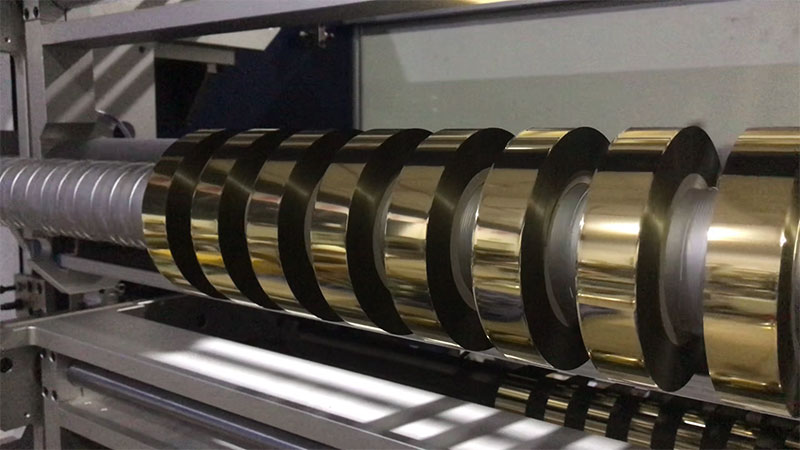
This article focuses on the two subsystems of unwinding and rewinding, explaining their functional composition, control logic, and key points of common adjustments.
21. October, 2026It is specifically designed to cut the wide master roll hot stamping foil into different narrow finished rolls according to process requirements, and is used in conjunction with hot stamping machines.
16. October, 2026A device with stable slitting accuracy and precise tension control is the fundamental link for ensuring hot stamping yield and material utilization.
16. October, 2026


 English
 Deutsch
 Français
 Español
 Português
 日本語
日本語 русский
 한국어
한국어 عربي
عربي ภาษาไทย
 Tiếng Việt
 Italiano