
Frequent foil breakage during the hot stamping foil slitting process is a tricky problem frequently encountered by many printing and packaging companies. Foil breakage not only affects production efficiency but also causes material waste and increases production costs. When faced with this situation, many operators' first reaction is to adjust the tension, but this often only addresses the symptoms, not the root cause. In fact, the causes of foil breakage mostly focus on four key components. By checking in order, problems are often solved.
1. Cutting blade
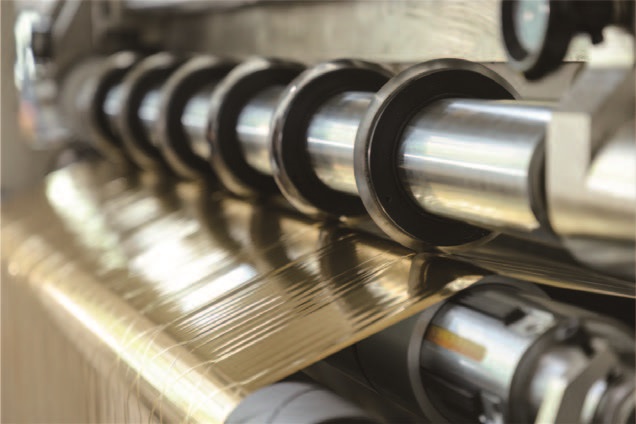
Blades are the most common source for splitting and cutting foil.
• Blade wear: After prolonged use, the blade edge becomes dull. During slitting, it no longer "cuts" the foil but "tears" it, causing tiny cracks at the edges that quickly expand under tension into a whole fracture. If you touch the knife edge with your finger and notice noticeable dullness or chipping, replace it immediately.
• Improper blade bonding pressure: excessive pressure between the upper and lower blades can compress the foil surface; too low will prevent cutting through. Check blade overlap (usually 0.05-0.1mm) and lateral pressure, then readjust according to the equipment manual.
• Blade angle issues: Foil foil of different thicknesses and materials requires matching blade angles. For example, thin electrochemical aluminum foil is suitable for sharper blades, while thicker hot stamping foil requires slightly larger cutting angles.
2. Guide rollers and foil rollers
The surface condition of the guide roller directly affects the stability of foil operation.
• Roller surface scratches or foreign objects: After long-term use, hard particles may become embedded in the surface of rubber or metal rollers, forming tiny bumps that repeatedly scrape the foil surface like a blade. Wipe the roller surface with a clean white cloth to check for roughness or obvious scratches. If necessary, use fine sandpaper to grind or replace the roller body.
• Roller surface adhesive layer: The adhesive layer on the back of the hot stamping foil tends to remain on the roller surface after friction heats, forming sticky zones that cause uneven foil running speed, local stretching overload, and breakage. Regularly clean the roller surface with specialized solvents.
• Poor roller rotation: Bearing jamming or poorly lubricated guide rollers can create additional frictional resistance on the foil surface, causing the foil to "slip" on the roller surface and be pulled off. Manually turn the wheel to check whether each guide roller rotates smoothly.
3. Static elimination device
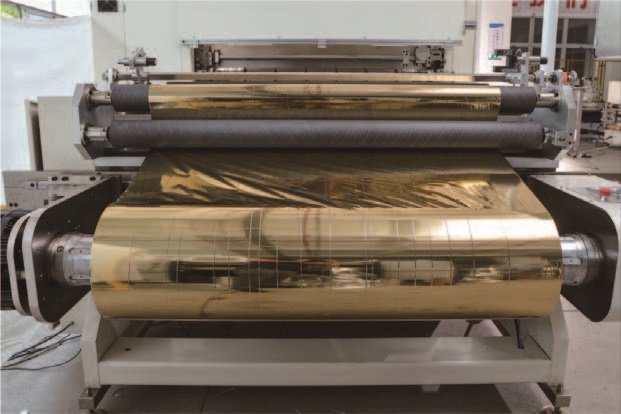
Static electricity is the "invisible killer" causing foil breakage, yet it is often overlooked.
Hot stamping foil is mostly made of plastic film substrate, which has good insulation and is prone to static electricity generated by high-speed friction during slitting. When static electricity accumulates to a certain level, the foil surface will adhere to the guide roller or frame, causing irregular sudden changes in resistance and instantly breaking the foil surface. Even more concealed, static electricity can cause the two slitted foil surfaces to adhere and entangle with each other, leading to secondary foil breakage.
The inspection method is simple: when the machine is running and the light is low, observe whether there are blue-violet electric sparks at the moment the foil surface leaves the guide roller, or use an electrostatic tester to measure the foil surface potential. If static electricity is obvious, check whether the static elimination rod has accumulated dust and failed, whether the high-voltage power supply outputs normally, and whether the grounding wire is secure.
4. Unwinding and rewinding tension systems
The tension system is the core control link of the entire equipment and is the most complex problem.
• Tension sensor failure: Many devices rely on tension sensors (tension swing arms or tension detection rollers) for automatic tension control. If the sensor is covered in dust or stuck mechanically, the feedback signal becomes distorted, and the controller will output incorrect tension commands. When the equipment is idling, observe whether the tension display stabilizes and returns to zero, and whether the values change linearly after static loading.
• Magnetic powder clutch/brake aging: This is the hardest hit area. The magnetic powder inside the magnetic powder clutch may clump or lose after long-term use, causing the output torque to be nonlinear, fluctuating between high and low. This is manifested as: normal tension at low speeds, but sudden foil breakage after accelerating to a certain speed. Listening for a noticeable "rustling" noise or jerking sensation during operation of the magnetic powder clutch can basically determine that the magnetic powder or assembly needs to be replaced.
• Improper setting of tapered tension: During winding, the diameter gradually increases, so to compensate for the difference in tension between the core and outer layers, a decreasing tapering tension needs to be set. If the taper coefficient is too small and the outer ring tension is too high, the inner foil is crushed and the outer layer breaks; If the taper is too large, the roll becomes loose and misaligned. Recalculate the taper curve based on the final diameter of the foil roll and material properties.
Comprehensive inspection recommendations
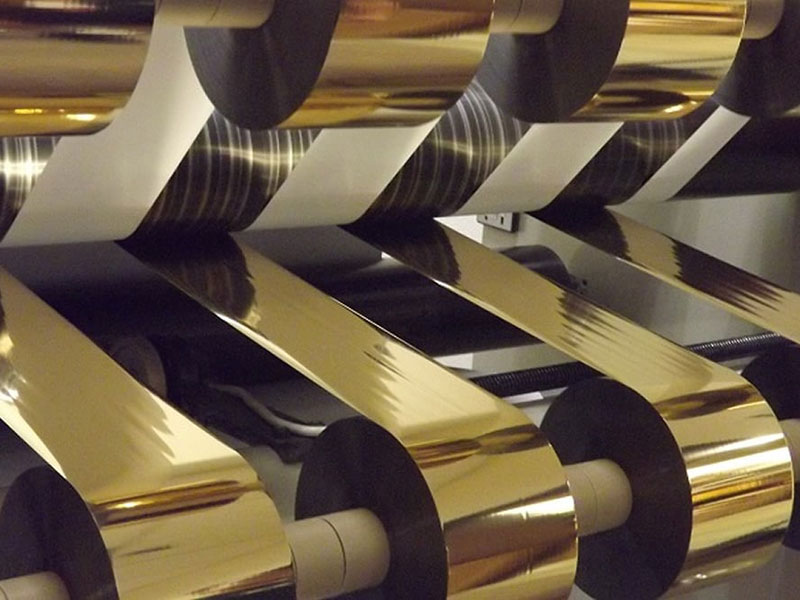
When foil breakage issues occur, it is recommended to quickly troubleshoot in the following order:
1. Observe the fracture shape: Neat straight cuts are usually caused by blade issues; Edges with burrs and tears mostly indicate blade dullness; If the cross-section is irregularly stretched, it is a tension issue.
2. Listen for sound: A sharp "squeak" sound at the blade indicates that the fit is too tight; Periodic "clicking" sounds at the guide roller may indicate bearing or surface foreign objects; The sound of static discharge is a static electricity issue.
3. Section inspection: Run the machine in three states: no-load, no foil cutting, and foil threading and slitting. Compare the working conditions when foil breakage occurs to identify whether the fault occurs in the unwinding, slitting, or rewinding sections.
In summary, foil foil separation and cutting are rarely caused by a single cause, but the vast majority of issues can be clued in the four components mentioned above. Establishing a routine inspection system, regularly cleaning guide rollers, checking blade status, and calibrating tension systems can significantly reduce foil breakage rates. When problems keep recurring, it's worth calming down and starting with these four components, investigating step by step.
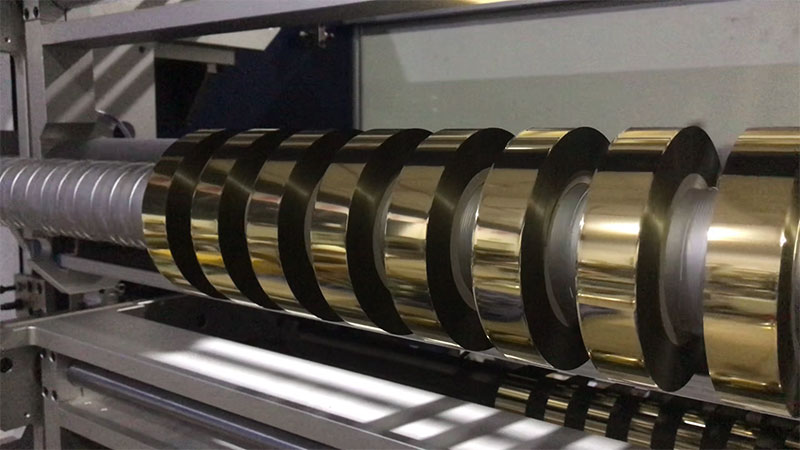
The tension control in the slitting stage directly determines the yield rate of subsequent hot stamping processes.
28. September, 2026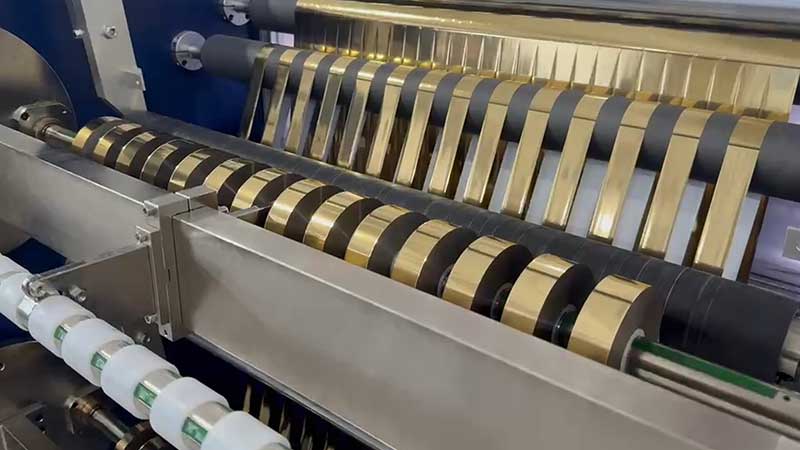
The key to selection is to grasp three parameters that truly determine slitting quality: slitting accuracy, tension control, and tool system.
28. September, 2026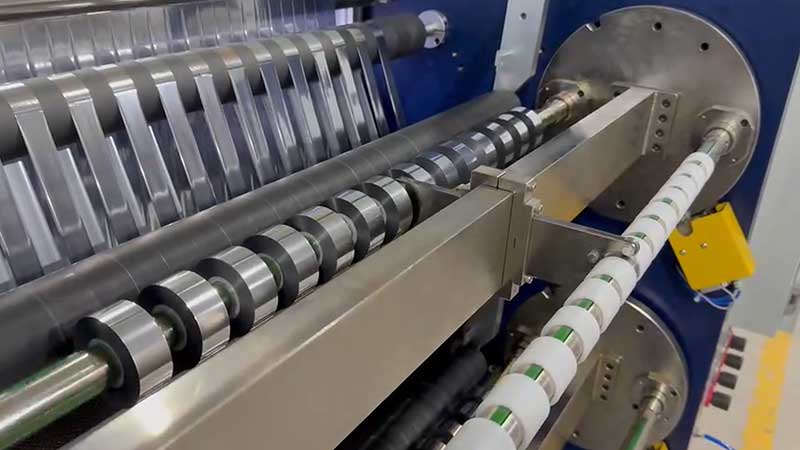
But what truly determines whether a slitting machine is "in sync" is not the absolute value of a single parameter, but the matching logic between width and speed.
28. September, 2026Width determines the rigidity and correction accuracy of the equipment's structure, while speed tests the real-time responsiveness of tension control.
24. September, 2026This article provides a current selection framework from four dimensions: material adaptation, core parameters, intelligent configuration, and cost evaluation.
24. September, 2026


 English
 Deutsch
 Français
 Español
 Português
 日本語
日本語 русский
 한국어
한국어 عربي
عربي ภาษาไทย
 Tiếng Việt
 Italiano