
During the slitting process of hot stamping foil, uneven edges are a headache for many operators. Uneven edges not only affect the product's appearance but may also lead to inaccurate positioning during subsequent stamping and an increase in defect rates. In fact, the vast majority of uneven edge issues can be quickly resolved through standardized calibration procedures.
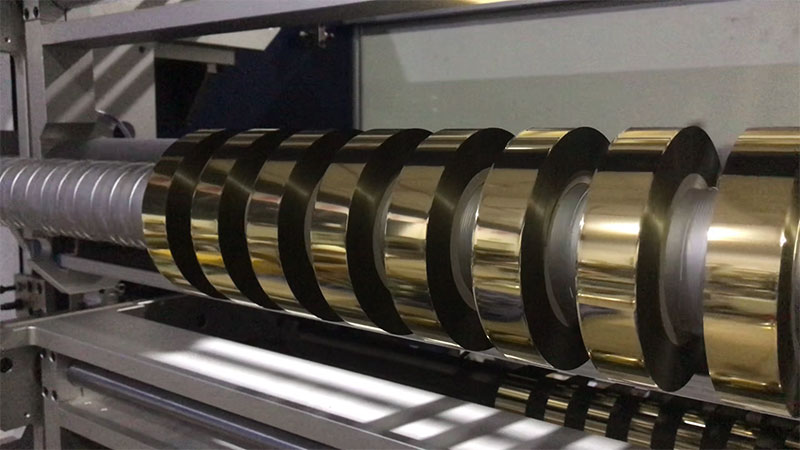
Why do uneven edges occur?
Before making any adjustments, first briefly identify the source of the fault. Uneven trimming usually manifests in three situations:
• Wavy edges: After slitting, the edges of the foil strip appear slightly wavy, often related to tension fluctuations or loose insert installation
• Burr-like edges: Fine hairs or debris at the edges, generally indicating dullness of the blade or improper spacing between upper and lower blades
• Overall misalignment: One side of the entire roll material is wider and the other narrow, usually due to misalignment of the guide rollers or failure to correct the unwinding deviation
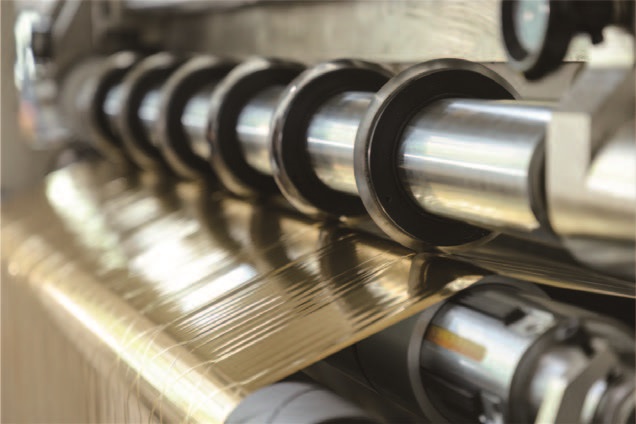
Identify the symptoms, then follow these three steps for calibration.
Step 1: Check and calibrate the blade status
1. Stop the machine and securely lock the equipment, and clean the blade shaft and any remaining hot stamping foil debris around it. Debris accumulation directly affects trimming quality.
2. Check the stacking amount of disc knives (upper and lower blades):
• The overlap depth on the sides of the upper and lower blades should generally be controlled between 0.5~1.5mm (depending on material thickness; for thin materials, the lower value is used).
• If the stacking amount is insufficient, the material cannot be cut; If the overlap is too large, it will cause compressed burrs
3. Adjust the blade clearance:
• Loosen the fixing screws on the upper and lower blade shafts
• Use feeler gauges or specialized measuring tools to adjust the lateral clearance between the blade edges; generally recommended is 0.03~0.08mm (equivalent to one-third to one sheet of A4 paper)
• For thinner hot stamping foil (such as 12μm or less), the gap should be as small as possible, "just cut off without squeezing."
4. Check for chipping or wear on the blade: If there are obvious notches, replace or grind them promptly.
Step 2: Adjust the slitting tension system
Unstable tension is the most common hidden cause of uneven trimming.
1. Check the unwinding tension:
• Manually pull the material to feel whether the resistance of the unwinding shaft is even. Common problems include air leakage in the expansion shaft or unstable output from the magnetic powder brake
• For models equipped with automatic tension controllers, check whether the deviation between the set value and the actual feedback value exceeds 10%.
2. Segmental testing tension:
• Run the equipment at low speed (about 10~20m/min) and observe whether the tightness of each foil strip after slitting is consistent
• If the middle strip is tight and the side strips are loose, it indicates that the leveling roller (curved roller) angle is improper or ineffective
3. Adjust the taper of winding tension:
• Excessive winding tension can "pull" the cut edges, especially noticeable in the latter half of the roll
• It is recommended to set the tension taper (Taper) to 15%~25%, meaning the tension gradually decreases as the diameter increases
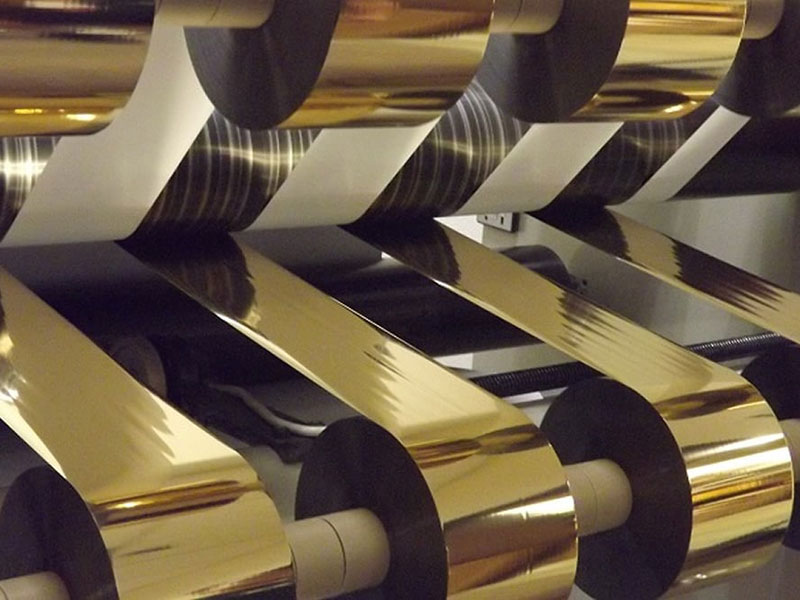
Step 3: Correct the guide roller parallelism and the correction system
If the blade and tension are normal but the cut edges are still uneven, the problem is most likely in the feeding path.
1. Check if all guide rollers are parallel:
• Use a tape measure or laser centerer to measure the distance from both ends of adjacent guide rollers to the frame reference plane; the difference should be ≤ 0.5mm/m
• Focus on checking the pressure rollers, traction rollers, and discharge rollers before and after slitting
2. Calibration correction device:
• Thread the material and run at low speed, observing whether the edges of the material are always within the detection range of the photoelectric/ultrasonic sensor
• If the material repeatedly "drifts" on the centering roller, clean the sensor lens and reset the "center" or "single-side" mode
• Manual testing of correction action: Cover one side of the sensor to see if the alignment roller moves in the opposite direction in time
3. Check for wear or adhesive on the roller surfaces: Uneven wear on the roller surface can cause material to move laterally; cleaning or grinding to fix it is sufficient.
Verification after calibration
After completing the above three steps, it is recommended to conduct verification tests:
• Take a slit sample about 5~10 meters long and unfold it on a flat table
• Use a ruler to measure width at different positions; deviation should be controlled within ±0.3mm/m (standard for ordinary industrial grade)
• Observe whether the edges are smooth, free of burrs, and free of periodic waves
If problems persist, check item by item: whether the blade clearance has shifted due to screws being tightened, whether the tension sensor is faulty, and whether the guide roller bearings are worn.
Prevent daily maintenance of uneven trimming
• Cleaning every shift: Remove foil powder and electrostatic debris from the blade shaft and guide roller
• Regular tool changes: Set tool change intervals based on the slitting meter, for example, grind the disc blade once every 100,000 minutes
• Record tension parameters: Create process cards for different specifications of hot stamping foil (thickness, width) to avoid arbitrary adjustments
• Check the air circuit: Leaks in the expansion shaft and deviation correction cylinder can cause intermittent trimming issues
Uneven edge cutting is often not caused by a single reason, but following the sequence of "adjust the blade first, then stabilize tension, then calibrate the guide roller," the vast majority of problems can be resolved within 30 minutes. If you still can't improve after following the steps above, feel free to leave a comment stating your equipment model and material specifications, and we'll analyze in depth together.
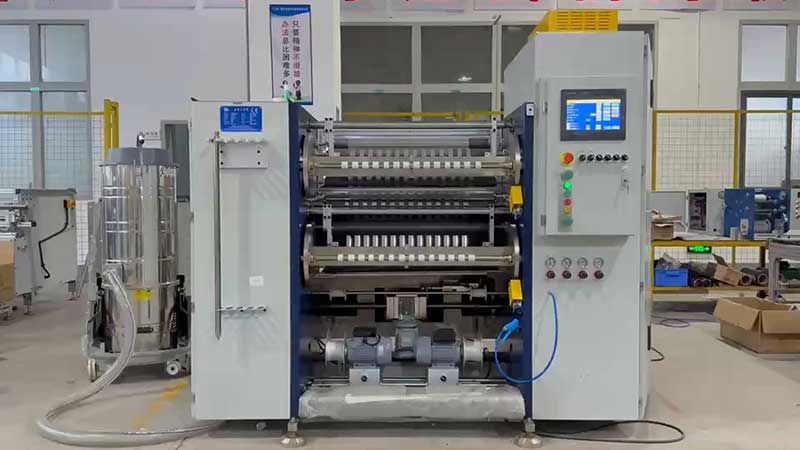
Whether you operate a slitting line or source slit rolls from a supplier, understanding these failure modes helps you protect quality and reduce downtime.
08. October, 2026
This guide breaks down the specifications that actually matter, organized by the parameters that directly affect your yield, efficiency, and bottom line.
08. October, 2026The tension control in the slitting stage directly determines the yield rate of subsequent hot stamping processes.
28. September, 2026
The key to selection is to grasp three parameters that truly determine slitting quality: slitting accuracy, tension control, and tool system.
28. September, 2026
But what truly determines whether a slitting machine is "in sync" is not the absolute value of a single parameter, but the matching logic between width and speed.
28. September, 2026


 English
 Deutsch
 Français
 Español
 Português
 日本語
日本語 русский
 한국어
한국어 عربي
عربي ภาษาไทย
 Tiếng Việt
 Italiano