
Driven by the global energy transition and the "dual carbon" goals, the new energy industry is iterating and upgrading at an unprecedented pace. As an indispensable link in the industry chain, new energy film slitting machines play the role of "finishers," and their technological level directly affects the performance and safety of core components such as lithium batteries and solar cells. This article will delve into the current application status, core technologies, and development trends of this equipment in the new energy sector.
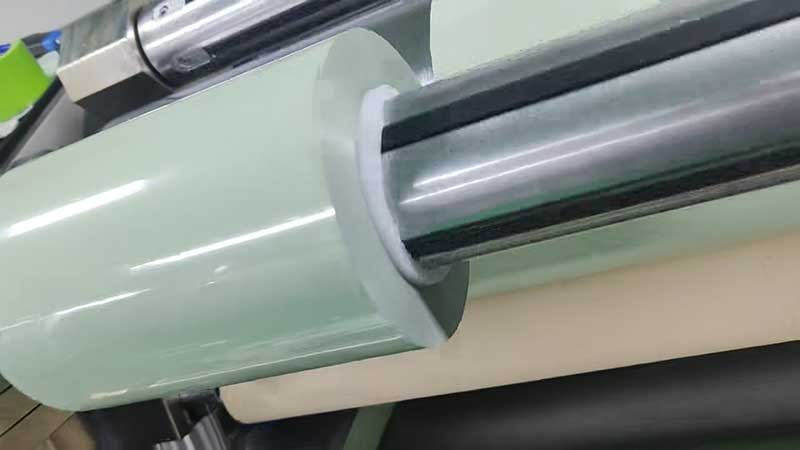
1. Core equipment for precision machining
The new energy film slitting machine is specialized equipment for cutting thin film materials in products such as solar panels, lithium-ion batteries, and fuel cells. These film materials (such as lithium battery separators, copper foil, aluminum foil, photovoltaic backsheet films, etc.) are typically thin, soft, and easily rolled, with thicknesses often at the micron level, and require extremely strict cutting precision and efficiency.
In lithium battery production, the slitting quality of the separator directly affects the internal short-circuit risk and consistency of the battery; In the photovoltaic field, the cutting precision of thin films affects photoelectric conversion efficiency and module reliability. Therefore, slitting machines are not just simple cutting tools, but also key lines of defense for ensuring the quality and safety of new energy products.
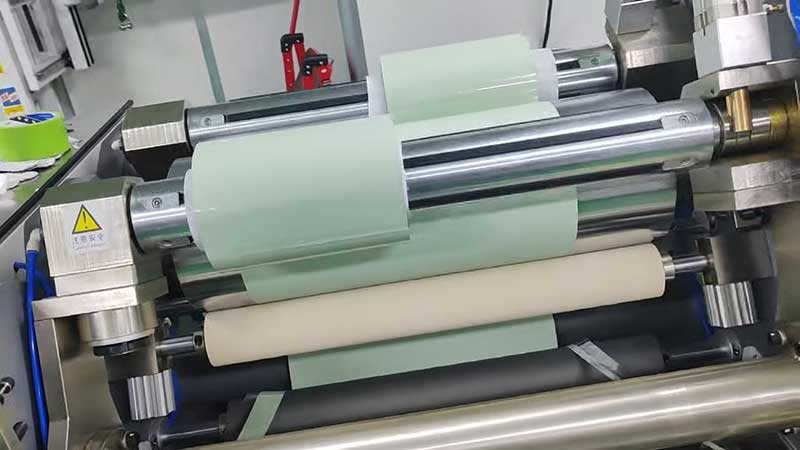
2. Key Technical Parameters and Performance Characteristics
Modern new energy film slitting machines integrate automation control, precision machinery manufacturing, and sensing technology, with their main performance features reflected in the following aspects:
1. Balance between high precision and high speed
The equipment must achieve micron-level cutting at high speed. Currently, mainstream equipment can operate at a maximum speed of up to 500 meters per minute, with finished product widths controlled at a minimum of 20mm, and material thickness processing ranges typically between 2~30μm. Taking laser slitting technology as an example, for anode coatings and cathode foils, the heat-affected zone can be controlled to ≤100μm, the bead diameter ≤10μm, and burr-free cutting is achieved, greatly improving the processing quality of electrode sheets.
2. Precise tension and correction control
Because film materials are prone to tensile deformation, tension control is the core of slitting yield. High-end equipment uses closed-loop tension sensor control with a fully automatic control mode, with a control accuracy of up to ±0.5N, ensuring the material remains flat during high-speed operation. At the same time, it is equipped with edge tracking/line tracking correction systems or CCD width detection closed-loop control, enabling real-time monitoring and adjustment of material positions to ensure precise slitting width.
3. Integration of intelligence and digitalization
With the advancement of Industry 4.0, slitting machines are no longer just standalone equipment, but have become an integral part of smart factories. The equipment supports data upload to MES (Manufacturing Execution System) and ERP (Enterprise Resource Planning) systems, enabling real-time monitoring and analysis of production data. Some models also feature automatic detection, automatic adjustment, and remote monitoring functions. By matching AGV automatic feeding, unmanned continuous production can be achieved.
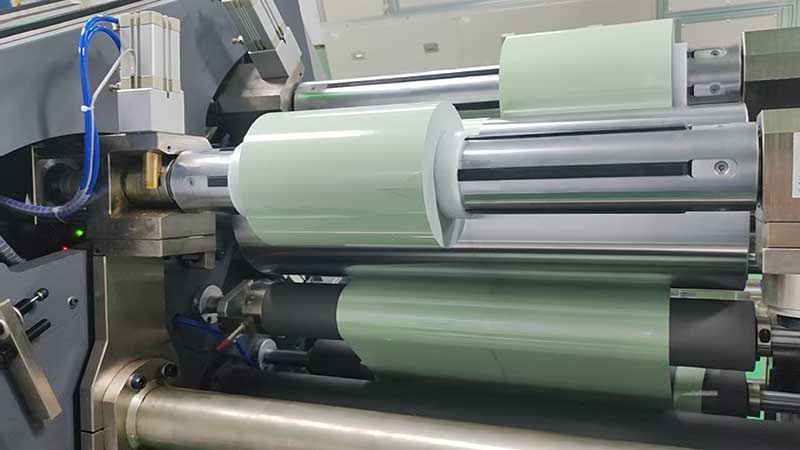
3. Application solutions for different materials
There is a wide variety of materials in the new energy sector, and slitting machines have evolved into targeted application solutions:
• Lithium battery separator slitting: Separators (PP/PE composite base films, coated films) require high thermal and chemical stability. The independent arm slitting machine uses low-tension control and a full-series main drive roller design to effectively prevent diaphragm stretching and deformation, ensuring a neat winding end face. By replacing the spacer sleeve and adjusting the slitting width and using ultra-fine tungsten steel blades, the slitting quality is free of waves and indentations.
• Optical film and special film slitting: For high value-added materials such as optical films and thermal insulation explosion-proof films, equipment places greater emphasis on dust removal and scratch prevention. The multifunctional digital slitting laminator integrates dust removal and static elimination devices, and uses slip shaft winding and proportional valve tension adjustment to accommodate membrane rolls of different thicknesses and materials.
• Innovative applications of laser slitting: For metal foil materials such as copper foil and aluminum foil, fiber laser slitting is becoming popular as an emerging process. Compared to traditional circular cutters, laser slitting is contactless and burr-free, capable of handling thinner and more brittle materials, and can monitor slitting width and surface quality online via CCD, even if NG information is fed back.
4. Future Development Trends
Looking ahead, new energy film slitting machines will evolve toward greater precision, intelligence, and flexibility. On one hand, with the industrialization of new technologies such as solid-state batteries and perovskite cells, equipment needs to adapt to thinner and wider substrates (currently, substrate widths have reached over 1650mm); On the other hand, the introduction of AI visual inspection and digital twin technology will enable equipment to self-optimize, using deep learning algorithms to predict strip break risks and automatically adjust process parameters, further improving yield and efficiency, and providing solid equipment support for the large-scale, high-quality development of the new energy industry.
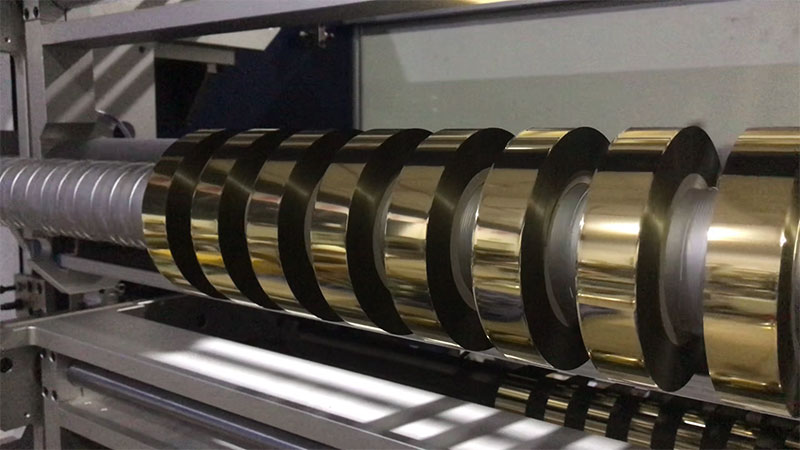
precise slitting directly determines the quality and production efficiency of hot stamping effects.
30. July, 2026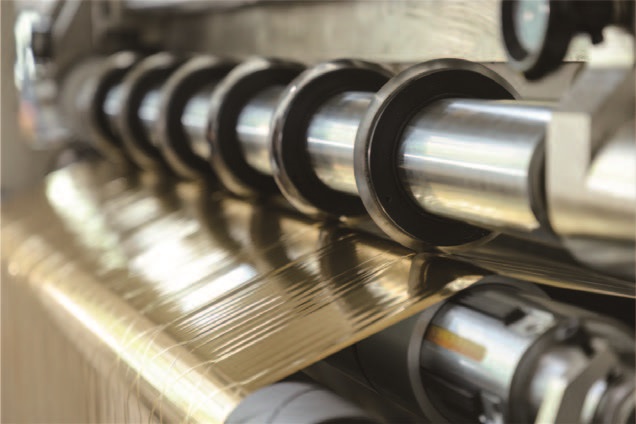
the new generation hot stamping foil slitting machine demonstrates strong flexible production capabilities.
30. June, 2026how can one select a truly value-creating device based on the three core dimensions of "precision, efficiency, and intelligence"?
26. June, 2026
This article will deeply analyze the innovative logic behind this energy efficiency revolution from three dimensions: technical principles, structural optimization, and practical application.
27. May, 2026These technological advances have not only driven leapfrog advancements in equipment performance but also redefined industry standards and production models.
26. May, 2026


 English
 Deutsch
 Français
 Español
 Português
 日本語
日本語 русский
 한국어
한국어 عربي
عربي ภาษาไทย
 Tiếng Việt
 Italiano