
Hot stamping foil is an ultra-thin material with a multilayer composite structure, with a total thickness of only 12–30μm. It consists of a PET base film, release layer, color layer, aluminum coating, and adhesive layer. This precise structure makes it extremely sensitive to tension—excessive tension causes the foil to stretch, deform, or even fracture; If the tension is too low, it will become loose and wrinkled when curled; Tension fluctuations cause the coil to tighten and loosen by the loop, all of which are quality hazards. There is a saying in the industry that "30% hot stamping, 70% cutting," clearly demonstrating the decisive impact of the slitting stage on the final stamping effect.
Avoiding foil breakage and wrinkling, the key lies in building a dynamically balanced micro-stress system. The following is a discussion from five key dimensions.
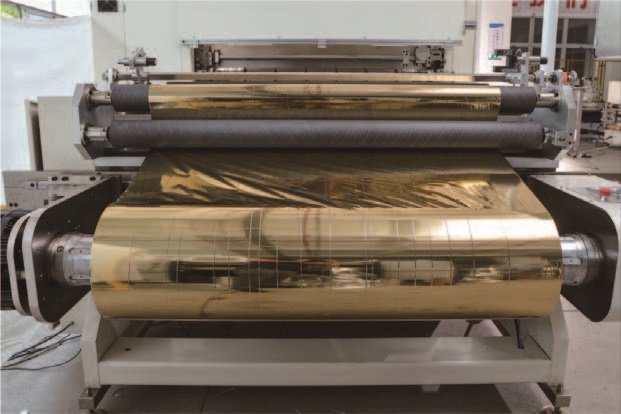
1. Abandon the "constant tension" mindset and use taper tension control
This is the most common operational mistake. Many operators are accustomed to setting a fixed tension value, but during slitting, the coil diameter keeps changing—the unwinding diameter gets smaller, while the winding diameter gets larger. If constant tension is used, the outer layer tension during winding will compress the inner layer, causing the inner ring to wrinkle (commonly known as "chrysanthemum core"), and the foil at the bottom of the large roll may be overstretched or even break during unwinding.
Taper tension control is a key strategy to resolve this contradiction: tension decreases according to a preset curve as the roll diameter increases. Typical parameter suggestions:
| Parameter items | Recommended values/range |
| Taper coefficient | 0.5–0.8 (for thin films, the value is considered higher) |
| Initial tension | 8%–12% of the material's fracture tension |
| Stop the tension | 40%–70% of the initial value |
| Tightening the tension | 80%–90% of slitting tension |
A more refined approach is segmented tension control: the starting section (0–20% roll diameter) uses lower tension to ensure the core is flat and fitting; The constant tension section (20%–70% roll diameter) maintains stable interlayer pressure; The taper descent section (70%–100% of the roll diameter) gradually reduces tension to compensate for the weight of the outer ring.
2. Emphasize dynamic compensation for moments of acceleration and deceleration
The moment the slitting machine starts, accelerates, slows down, and stops is the most intense tension fluctuations. If the inertial impact caused by speed changes is not compensated, it will directly act on the foil, causing foil breakage or coating drawing.
Solution: Choose a slitting machine equipped with pre-acceleration compensation and inertia compensation functions. High-end equipment adopts a "speed + current" dual closed-loop architecture, combined with dynamic feedforward compensation, which calculates the inertia effect caused by changes in coil diameter in real time, and adds torque compensation during acceleration and deceleration. Modern direct-drive torque motors can control response delay within 5ms. At a sudden speed change of 500m/min, tension overshoot is only 0.8N, with recovery time of about 80ms, whereas traditional PID solutions overshoot reaches 3.5N and recovery takes 400ms.
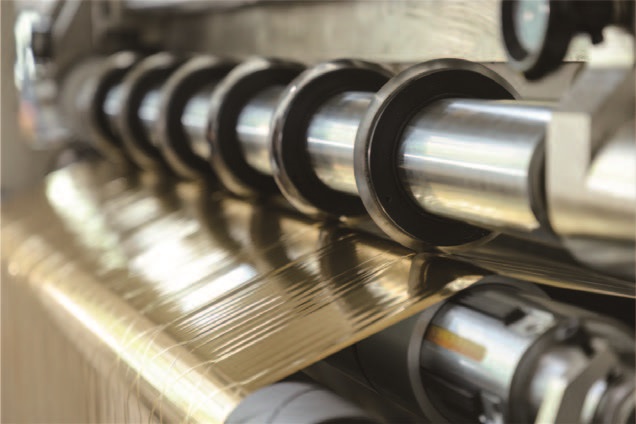
3. A "zero-fluctuation" zone must be established at the slitting knife area
This is the easiest to overlook yet the most critical link. If the material at the slitting blade shakes with fluctuations in tension, the blade will cut like a "saw," producing microscopic serrations—this is the root cause of gold-foil edges and broken foil.
Solution: Modern high-end slitting machines are designed with multiple independent tension control zones—unwinding zone, traction zone (before and after slitting blades), and winding zone. It is essential to ensure that the material at the slitting blade is in a "zero tension fluctuation" state, with real-time feedback from the floating roller or tension sensor to isolate the fluctuations outside the cutting area.
At the same time, the condition of the tool itself directly affects foil breakage: when the blade becomes blunt, it no longer "cuts" the foil surface but "tears," causing tiny cracks at the edges that expand under tension into a whole fracture. The overlap between upper and lower blades should usually be controlled between 0.05–0.1mm.
4. Hardware matching for the unwinding end: Coordination between the expansion shaft and the magnetic powder brake
80% of tension instability faults on site actually point to poor coordination between the expansion shaft and the magnetic powder brake at the unwinding end.
Expansion shaft pressure: Standard set is 0.4–0.6MPa (0.4–0.5 for paper cores, 0.5–0.6 for plastic or aluminum cores). Within 5 minutes after inflation, the pressure drop should not exceed 0.05MPa; otherwise, it indicates slow air leakage, causing fluctuating unwinding resistance.
Magnetic powder brakes: Long-term operation at low current can cause magnetic powder caking. For magnetic powder brakes used for more than a year, it is recommended to increase the set current by 10%–15% to compensate for performance degradation. If the housing temperature exceeds 90°C, it indicates excessive slippage over a long period, and check whether the selection is too small.
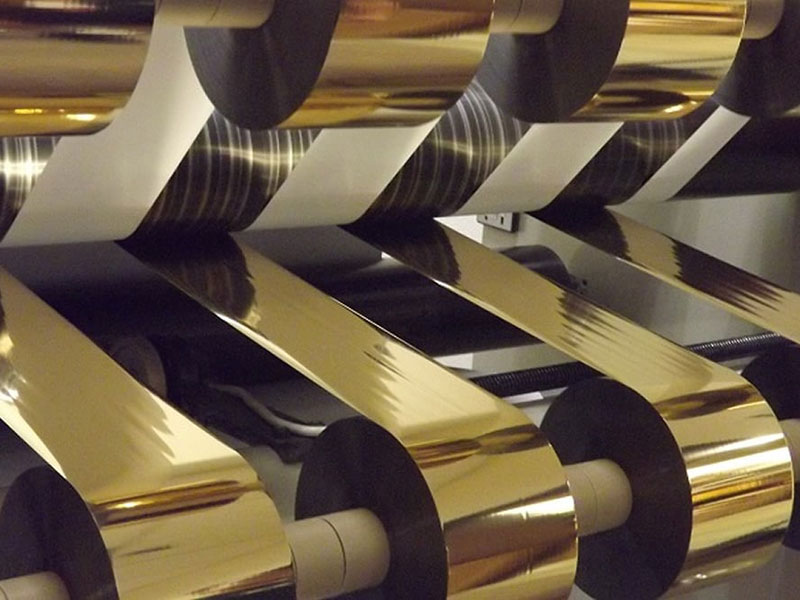
5. Linkage management of rewinding and pressing rollers
When winding thin hot stamping gold foil, air easily gets introduced, causing uneven ends or wrinkling. Poor roller condition is a common trigger.
Key points:
• Parallelism: If the roller axis and the winding shaft axis are not parallel, the pressure deviation between left and right will cause one side of the foil surface to be tight and the other side loose, making the loose side very prone to wrinkling. Industry standards require the left-right pressure deviation to be controlled within ±3N, and the parallelism deviation not exceeding 0.05mm/m.
• Hardness: Hot stamping foil should be made of polyurethane or nitrile rubber rollers with a Shore A hardness of 60–75.
• Pressure linkage: At the initial stage of winding, the diameter is small, requiring high contact pressure to expel air; After winding, as the diameter increases, the contact pressure should gradually decrease to prevent end face compression deformation. Avoid falling into the contradictory state of "low outer tension and high roller pressure"—this is a common root cause of foil surface wrinkles.
Summary: To avoid separating and wrinkling hot stamping foil, a single measure cannot be relied upon. Instead, it requires coordinated efforts from five dimensions: taper tension control, dynamic compensation, zoned isolation, hardware matching at the unwinding end, and roller linkage. Prioritize checking whether the expansion shaft is leaking air, whether the taper tension curve is enabled, and whether there is an independent tension stabilizer zone at the slitting blade—these three steps can solve most on-site problems. Experimental data show that with precise taper tension control, the incidence of uneven end faces and wrinkled defects can be reduced by 40%–60%.
It is specifically designed to cut the wide master roll hot stamping foil into different narrow finished rolls according to process requirements, and is used in conjunction with hot stamping machines.
16. October, 2026
A device with stable slitting accuracy and precise tension control is the fundamental link for ensuring hot stamping yield and material utilization.
16. October, 2026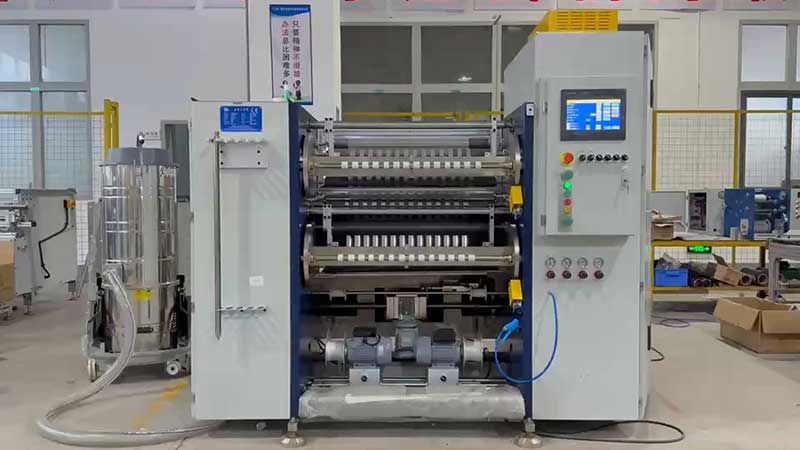
Whether you operate a slitting line or source slit rolls from a supplier, understanding these failure modes helps you protect quality and reduce downtime.
08. October, 2026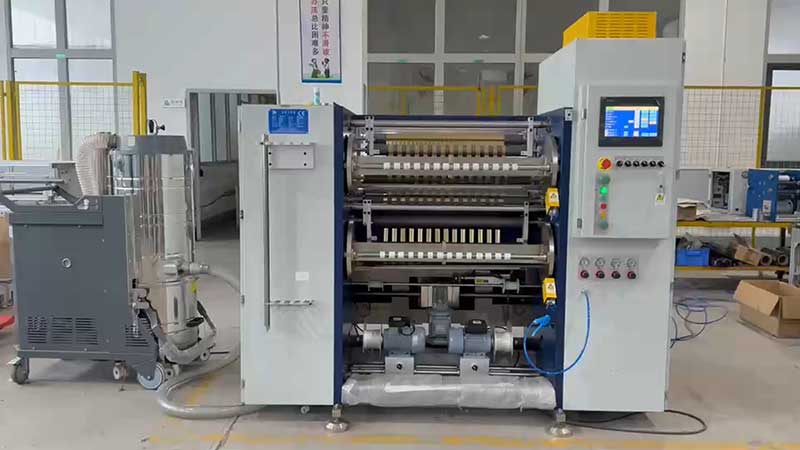
This guide breaks down the specifications that actually matter, organized by the parameters that directly affect your yield, efficiency, and bottom line.
08. October, 2026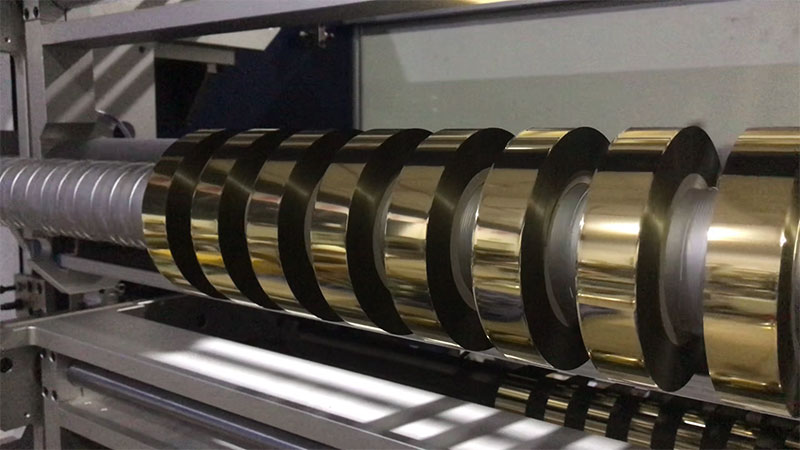
The tension control in the slitting stage directly determines the yield rate of subsequent hot stamping processes.
28. September, 2026


 English
 Deutsch
 Français
 Español
 Português
 日本語
日本語 русский
 한국어
한국어 عربي
عربي ภาษาไทย
 Tiếng Việt
 Italiano