

The principle of the slitting machine:
1. The paper slitting machine needs to cut the whole roll or the whole piece of raw materials to the fixed length, such as plastic packaging materials, packaging boxes, steel plates, films, leather, sawdust, etc., all of which need to be controlled by fixed length slitting.
2. The cutting length can be set continuously. If there is an error in the actual cutting length, it can be easily calibrated by setting the parameters.
3. The slitting control of the paper slitting machine is divided into two types: static slitting and dynamic slitting: stop accurately when the set length is reached, then carry out static slitting processing, and restart the operation after slitting; when the set length is reached, the cutting signal is sent without stopping the machine, and the cutting machine dynamically cuts and processes in the process of material movement.
Structural advantages of slitting machine:
1. The central part of the paper core slitting machine is equipped with a spindle for processing paper cores. The front end of the spindle is fixed on the base with a group of bearings, and a pulley is installed in the middle of the bearing group; a compressed cylinder is installed near the base, and the upper end of the cylinder support rod is equipped with a group of support rod bearings, which is used for supporting the spindle.
2. The upper end of the paper tube slitting machine is provided with the main knife shaft, and a plurality of blades are arranged on the main knife shaft according to a certain clearance; the top of the paper tube slitting machine is also equipped with the support frame of the main knife shaft, and the middle of the support frame is equipped with a support cylinder.
3. The structural advantages of the paper tube slitting machine fill the technical gap of the automatic slitting machine.
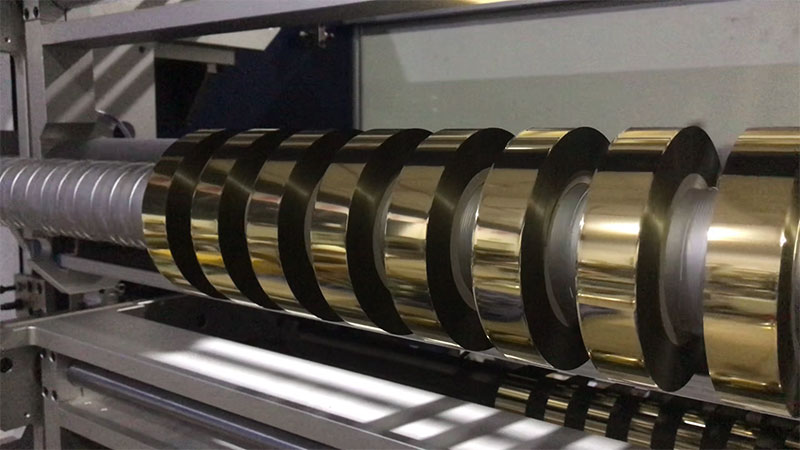
Width determines the rigidity and correction accuracy of the equipment's structure, while speed tests the real-time responsiveness of tension control.
24. September, 2026
This article provides a current selection framework from four dimensions: material adaptation, core parameters, intelligent configuration, and cost evaluation.
24. September, 2026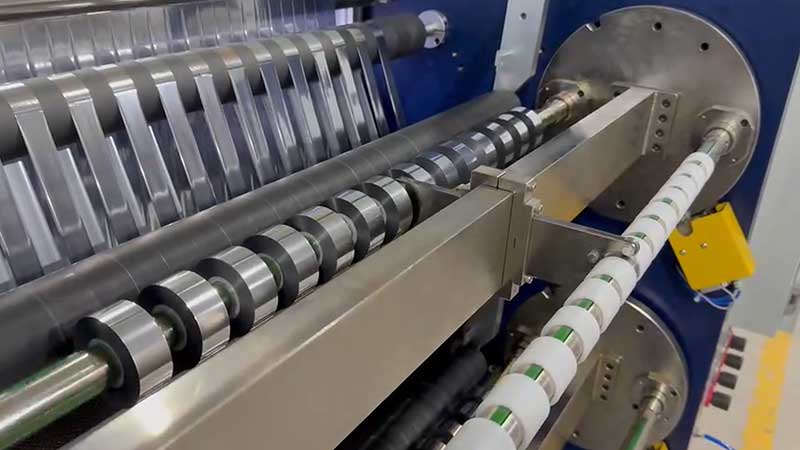
Faced with the wide variety of promotions in the market, buyers only need to focus on five core dimensions to avoid most pitfalls.
24. September, 2026
The first watershed in choosing a model isn't speed or brand, but rather — which type of ribbon do you mainly cut?
23. September, 2026
When asking suppliers the following seven questions, the quality of the answers is far more valuable than the numbers on the parameter table.
21. September, 2026


 English
 Deutsch
 Français
 Español
 Português
 日本語
日本語 русский
 한국어
한국어 عربي
عربي ภาษาไทย
 Tiếng Việt
 Italiano