
Film slitting machine is a key equipment in film processing, mainly used to cut wide film coils into narrow rolls of specific width to meet the application needs of different industries. The following is a detailed breakdown of its core functions and applicable scenarios:
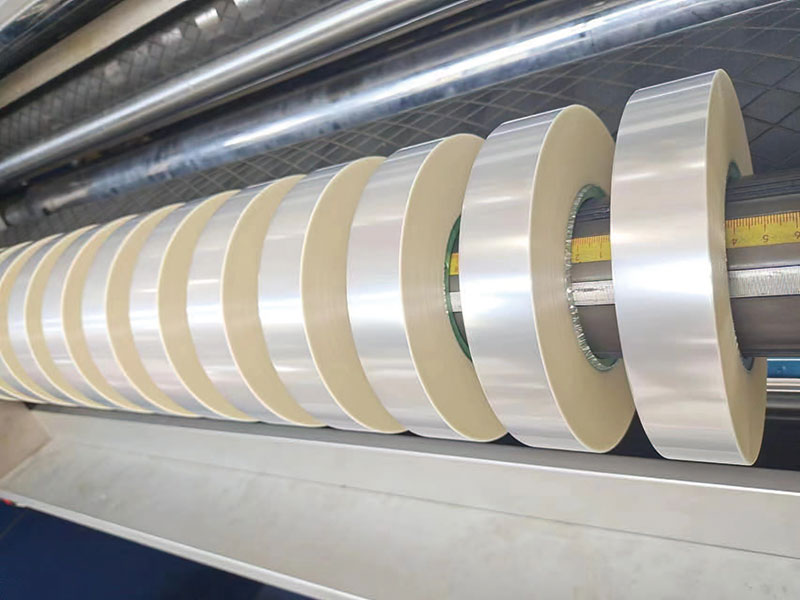
1. Core functions
1. High-precision slitting
◦ Servo control system or high-precision tool holder is used to ensure that the slitting width error is controlled within ±0.1mm, which is suitable for optical film, electronic packaging film and other fields with high precision requirements.
2. Multi-material compatibility
◦ It can handle a variety of materials such as PE, PP, PET, PVC, BOPP, aluminum foil composite film, etc., and can adapt to different material characteristics by adjusting the tension system and tools.
3. Diversified slitting methods
◦ Blade slitting: suitable for thicker films (such as packaging films);
◦ Air knife slitting: for films that are easy to adhere (such as adhesive tape);
◦ Round knife slitting: high-speed scenarios (such as continuous production on an assembly line).
4. Automatic tension control
◦ Equipped with a magnetic particle brake or closed-loop tension system to prevent film stretching and deformation or wrinkling, especially for ultra-thin films (e.g., ≤5μm) processing.
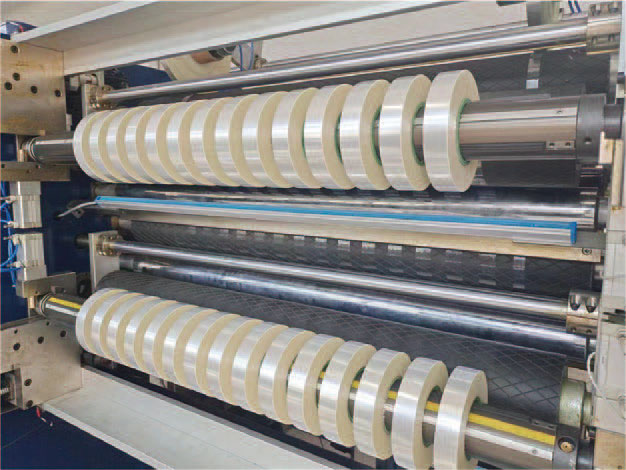
5. Edge trimming and scrap recycling
◦ Automatically remove burrs and collect waste through waste suction devices to improve yield and keep the production environment clean.
6. On-line detection and correction
◦ Integrated CCD camera or photoelectric sensor to monitor the position of the edge of the film in real time, automatic deviation correction (accuracy ± 0.5mm), reducing manual intervention.
2. Extended function (high-end model)
• Intelligent setting and memory: store the slitting parameters of different products and quickly switch specifications.
• Thickness monitoring: Detect film thickness uniformity by β-ray or ultrasonic sensor.
• Pre-coating slitting: Support the slitting of coated functional films (such as anti-UV films) to avoid coating damage.
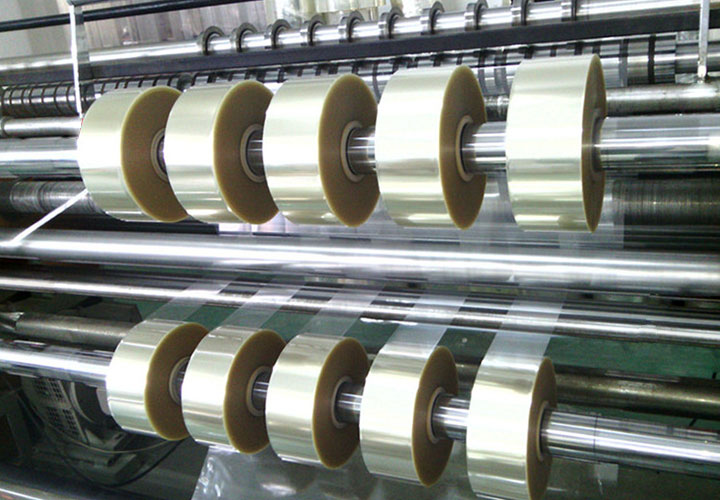
• Multi-axis winding: Output multiple narrow reels (e.g. 8-12 spindles) at the same time to improve efficiency.
3. Application scenarios
| industry | Typical uses | Slitting requirements |
| packaging industry | Food bags, express bag substrate | High-speed slitting (≥300m/min), simultaneous output of multiple rolls |
| Electronics industry | Lithium battery separator, flexible circuit board covering film | Dust-free environment, ultra-high accuracy (±0.05mm) |
| Medical industry | Medical dialysis paper, protective clothing film | Clean slitting, no pollution |
| Construction industry | Glass heat insulation film, waterproof membrane | Thick film slitting (≥ 200μm), strong winding |
| New energy | Photovoltaic backsheet membranes, fuel cell modules | High-temperature resistant tools, anti-static design |
Fourth, the selection of suggestions
• Narrow web slitting (< 500mm): choose desktop slitting machine, suitable for laboratory or small batch production.
• Wide high speed (>2m, 500m/min): need to be equipped with hydraulic tool change and automatic logistics system.
• Special materials: such as easy-to-stretch TPU film, low-tension model + contact winding should be selected.
Through the combination of the above functions, the film slitting machine can cover the processing needs from daily packaging to cutting-edge electronic materials, and users should choose the appropriate model according to their own material characteristics, capacity and accuracy requirements.
This article outlines a clear selection approach from four dimensions: material adaptation, core technical parameters, efficiency and cost, and supplier selection.
09. September, 2026Balancing speed and precision in film slitting machines is essentially a test of "control capability."
02. September, 2026This article will delve into the current application status, core technologies, and development trends of this equipment in the new energy sector.
28. August, 2026the film slitting machine is the core equipment for slicing wide, large rolls into narrow rolls of specific specifications.
26. August, 2026Tension control technology for thin film slitting machines involves interdisciplinary integration of control theory, mechanical design, and material mechanics.
26. August, 2026


 English
 Deutsch
 Français
 Español
 Português
 日本語
日本語 русский
 한국어
한국어 عربي
عربي ภาษาไทย
 Tiếng Việt
 Italiano