
In the sophisticated landscape of modern manufacturing, solar film production is a field that requires high precision, stability, and continuity. From the coating and compounding of the master roll to the final delivery to the customer or the next process (e.g., cutting, packaging), the smooth flow of every step is crucial. In this process, the solar film slitting machine is often seen as the "last mile" of production, but its role is far from a simple "cutting tool". In fact, an efficient and intelligent slitting machine is the key engine to open up the production line and achieve a multiplication of overall collaborative efficiency.
Traditional slitting often becomes a production bottleneck. The slitting speed cannot keep up with the production rhythm of the previous coating, the time required for reel change alignment is too long, and the slitting accuracy is insufficient, resulting in frequent shutdown and adjustment of the subsequent process...... These problems cut off the continuity of the production line and caused a hidden loss of efficiency. The modern high-performance solar film slitting machine is through technological innovation to deeply empower the production line from the following aspects and achieve a leap in collaborative efficiency.
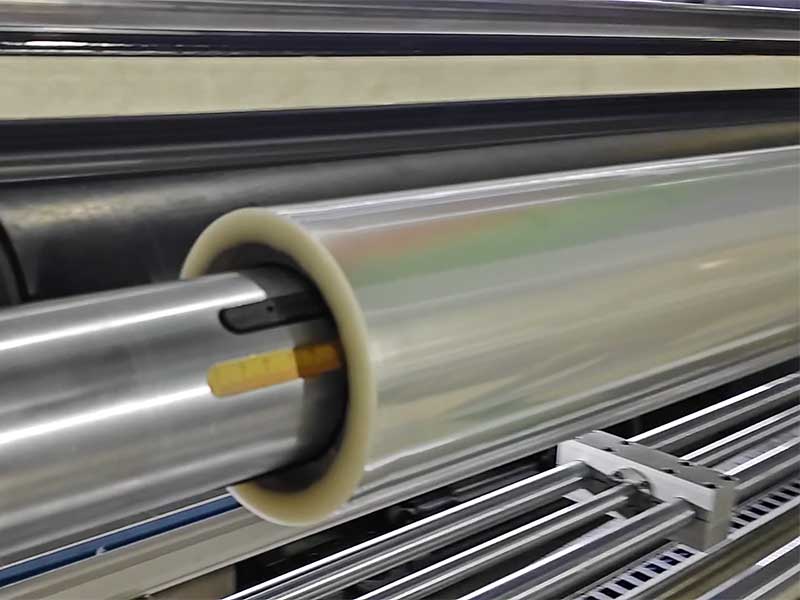
1. The perfect balance of speed and precision to eliminate production bottlenecks
The overall efficiency of the production line follows the "barrel effect", and the slowest link determines the overall output. Solar film coating lines often operate at high speeds and wide widths, and the resulting large master coils need to be quickly and accurately slitted into various specifications. Advanced slitting machines break bottlenecks by:
• High-speed constant tension control: The use of sophisticated servo drive system and closed-loop tension control algorithm can ensure constant film coil tension at slitting speeds of up to hundreds of meters per minute, avoiding stretching, wrinkling, or uneven winding caused by speed fluctuations. This allows the slitting speed to perfectly match the previous coating speed, achieving "production and dispensing" and eliminating intermediate inventory backlogs.
• High-precision positioning and correction: Solar films require extremely high edge accuracy (especially in applications such as photoelectric displays). The slitting machine equipped with a high-sensitivity sensor and a fast response correction system can track the edge of the film coil in real time and control the slitting error to the micron level. This not only ensures the quality of the finished product, but more importantly, provides raw materials with highly consistent specifications for subsequent processes (such as automatic laminating machines), reduces frequent adjustments and downtime caused by incoming material deviations, and realizes seamless connection between processes.
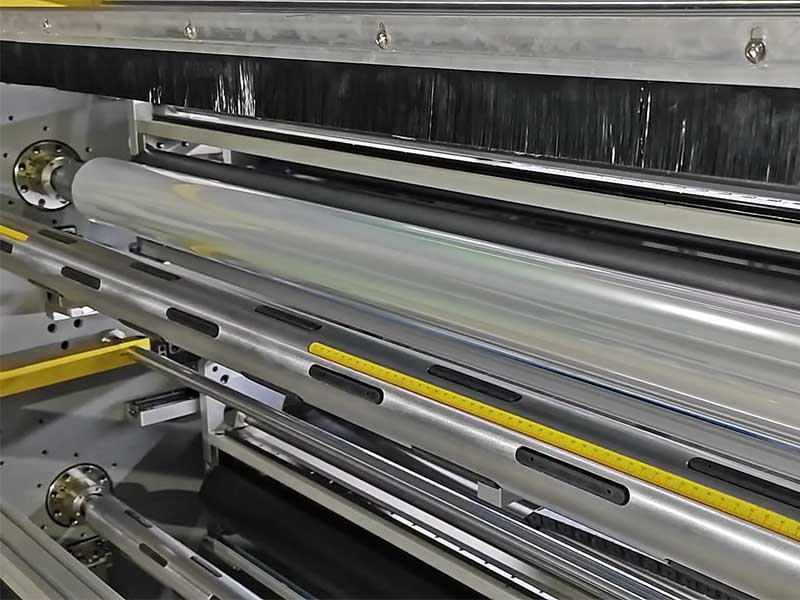
2. Intelligence and automation reduce human intervention and waiting
Interruptions in the production process often stem from the inefficiency and instability of manual operations. Modern slitting machines are developing in the direction of high automation and intelligence, which greatly improves the collaborative smoothness of production lines.
• Automatic rewinding and unloading: The slitter equipped with an automatic reel changing tower and unloading system can complete the unloading of full reels and the preparation of new paper tubes without stopping the machine, compressing the rewinding time from minutes to tens of seconds. This not only significantly increases the effective uptime of the machine, but also makes the entire production cycle time more compact and predictable.
• Parameter preset and recipe management: For solar film of different specifications and materials, the slitting machine can store hundreds of "recipes". The operator only needs to call up the recipe, and the machine can automatically adjust the tool pitch, tension, pressure and other parameters. This not only shortens the product changeover time and enables flexible production of "small batches, multiple batches", but also ensures the stability and consistency of each production, allowing the production line to quickly respond to changes in market demand.
• Fault Self-Diagnosis and Early Warning: Intelligent slitting machines can monitor their operating status in real time, predict potential faults (such as tool wear, bearing overheating), and issue early warnings before problems occur. This predictive maintenance capability effectively avoids unplanned downtime, ensures the smooth execution of production plans, and maintains the stability of the entire production line.
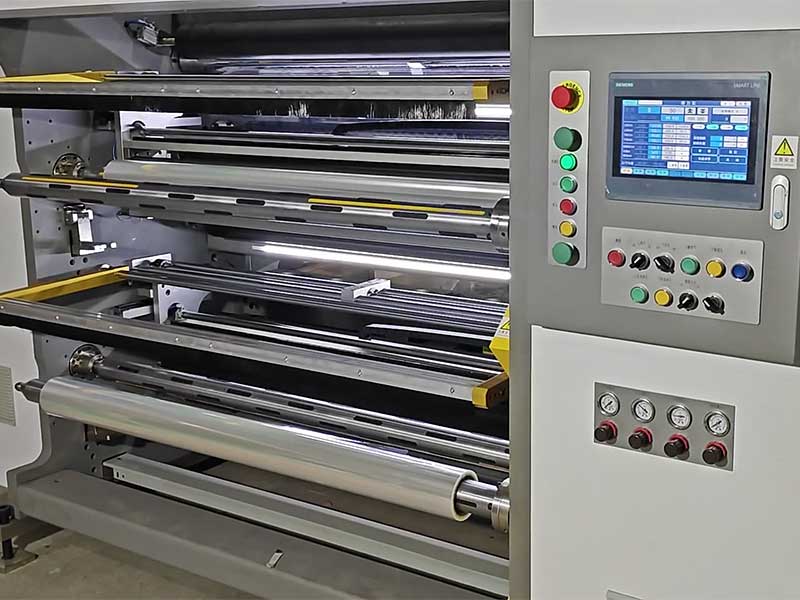
3. Optimize material flow to improve space and personnel efficiency
The slitting machine is not only the processing equipment, but also the core node of production logistics. Its optimization leads to improved material flow throughout the shop floor.
• Neat winding quality: Excellent winding mechanisms (e.g., contact/gap winding) ensure that the finished coil ends are flat and the internal and external tension is uniform. This is crucial for subsequent packaging, warehousing, and transportation. Neat coils are easy to stack and handle, reducing storage space occupation and avoiding the problem of coil deformation being unusable in the later process.
• Reduced scrap and loss: Precise tension control and defect detection systems automatically remove defective parts during the slitting process and accurately record the location of scrap products. This reduces the waste of high-quality substrates, and also prevents non-conforming products from flowing into the next link, improving the yield rate and material utilization rate of the overall production line from the source.
• Simplified operation and human collaboration: Human-machine friendly interface, automated loading and unloading system, reducing the reliance on operator skills and experience. A skilled operator can take care of multiple slitting machines at the same time or take care of both the front and rear processes, realizing the optimal allocation of human resources.
Conclusion: From "Slitting Point" to "Synergy Surface"
The solar film slitting machine is no longer an isolated "point" at the end of the production line. Through technology empowerment, it has become a "synergistic surface" connecting multiple links such as coating, rewinding, inspection, and packaging. It ensures the smooth flow of materials with high speed and high precision; Reduce the delay and interruption of information flow with intelligence and automation; Stable and reliable operation supports the cycle time of the entire production system.
When the slitting machine can synchronize with the production speed of the previous end, provide the perfect raw material for the subsequent process, and can self-diagnose and flexibly switch, the entire production line transforms from a "serial system" that can break the flow to an efficient and collaborative "parallel network". This systematic efficiency improvement brought about by the breakthrough of key equipment is the "synergy" pursued by modern manufacturing, and it is also the key to building core competitiveness in the fierce market competition of solar film manufacturers.
High-precision slitting machines protect film performance within seconds through precise control of blade, tension, and positioning in an integrated manner.
25. August, 2026This process may seem simple, but in reality, it is a high-tech step integrating precision machinery, automatic control, and materials science.
17. August, 2026This article will provide an in-depth analysis of the two core pillars of high-precision solar film slitting machines: tension control and closed-loop correction.
06. July, 2026In other words, for every 100 rolls of finished film, 5 to 8 rolls of value silently disappear during the slitting process.
01. July, 2026The root cause of the problem is often the same: after static charge accumulates, there is no smooth discharge channel.
23. June, 2026


 English
 Deutsch
 Français
 Español
 Português
 日本語
日本語 русский
 한국어
한국어 عربي
عربي ภาษาไทย
 Tiếng Việt
 Italiano