
Walking into any car detailing shop, the shelves are filled with a dazzling array of sun film rolls, and from the outside, they seem almost indistinguishable. But what truly determines whether a film is "premium" or "inferior" often lies not in its color or material, but in an easily overlooked step—the cut.
The slitting machine, the key device that breaks wide mother rolls into pieces, is considered the ultimate quality gatekeeper in solar film production. If it misses even a tiny margin, the end product can be far from the end. This article will provide an in-depth analysis of the two core pillars of high-precision solar film slitting machines: tension control and closed-loop correction.
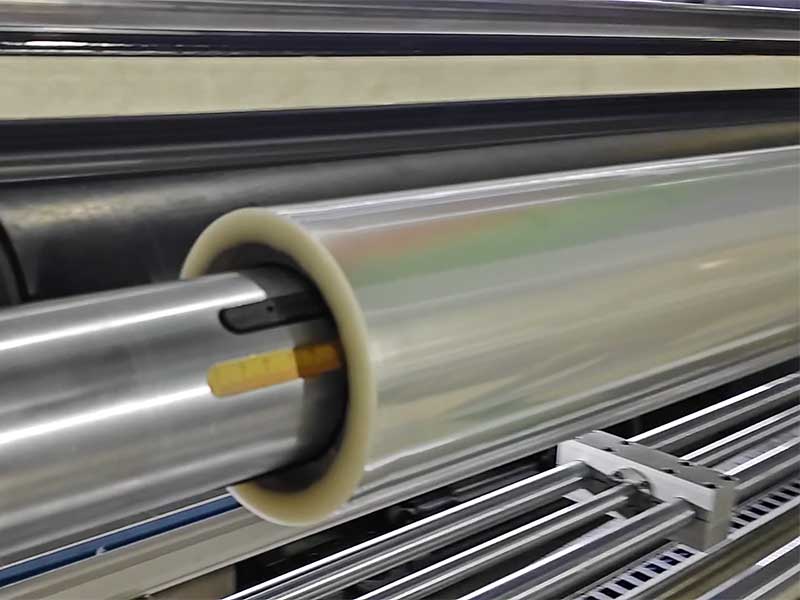
1. Tension Control: The "Anchor" for Stable Production
Solar film is a multilayer composite material, thin and soft, with varying elastic modulus and elongation between layers. This means it is extremely "sensitive" during slitting, and even slight tension imbalance can trigger a chain reaction.
1. The Price of Losing Control: From Stretching to Wrinkles
If tension control during slitting is inadequate, it will directly affect product quality:
• Dimensional deviation: excessive tension thinning and elongation of the film, releasing stress after winding, resulting in actual width less than the set value; If the tension is too low, the membrane surface becomes loose, causing frequent deviation and displacement.
• Appearance defects: Uneven tension can cause "ruffle edges" or wavy folds on the film edges, and in severe cases, "telescope" phenomena—uneven end surfaces after winding.
• Internal damage: Tension fluctuations may also cause the film surface to slide relative to the guide roller, forming axial scratches.
2. Closed-loop control intelligence: millisecond-level dynamic adjustment
The soul of modern high-end slitting machines lies in their closed-loop digital tension control system. It is not simply about setting a fixed value at startup, but rather a real-time dynamic adjustment process.
This system subdivides the slitting process into unwinding, traction, and winding zones, each with its own independent tension detection and feedback unit. Highly sensitive tension sensors monitor the membrane tension in real time, feeding the signal back to the PLC, which then performs millisecond-level dynamic adjustment via servo motors or vector variable frequency motors.
The most ingenious design among these is the taper tension curve algorithm. During winding, as the film roll diameter increases, maintaining constant tension will cause the inner film to be compressed and deformed. Taper tension control automatically reduces tension according to preset curves as the coil diameter increases, ensuring consistent tightness and flatness inside and outside the coil.
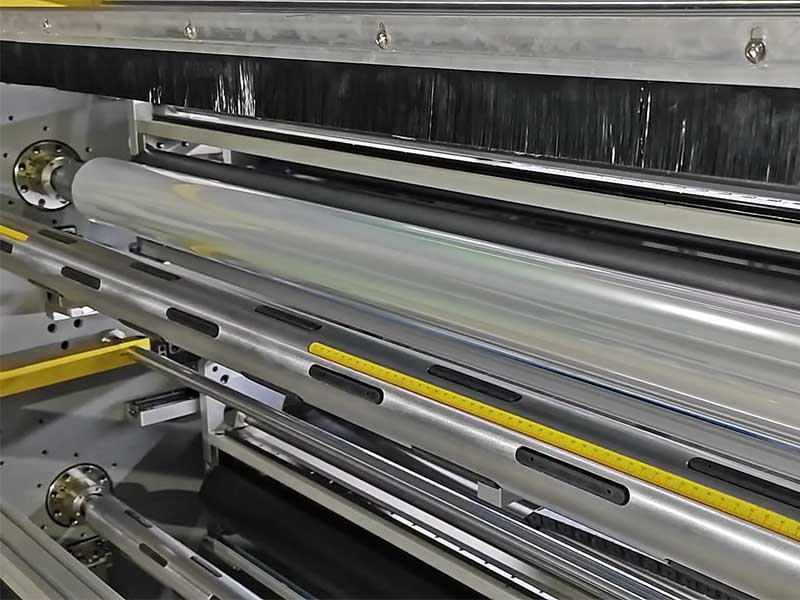
2. Closed-loop correction: ensuring the "compass" for material delivery
If tension control tubes provide "longitudinal" stability, then closed-loop centering tubes have "lateral" precision. During high-speed travel, the solar membrane is easily affected by factors such as roller parallelism and uneven material thickness, making lateral deviation easily occur. If not corrected, the result is uneven edges, or even cutting to the effective film layer, resulting in immediate failure.
1. Precise "eyes" and "hands and feet"
The working principle of the closed-loop correction system is similar to human conditioning, consisting of three core components:
• Detection (eye): Using ultrasonic or photoelectric edge detectors, scans the edge position of the film roll in real time to precisely capture micron-level lateral deviation.
• Computation (brain): The controller compares the detected position signal with the set value, calculates the deviation amount, and issues correction instructions.
• Execution (hands and feet): After receiving the command, the high-precision linear motor or servo-driven straightening mechanism quickly activates, pushing the unwinding frame or straightening roller to move laterally and pulling the film back to the correct trajectory.
Currently, mainstream equipment can stably control the correction accuracy at ±0.1mm, and some high-end lithium battery or optical film slitting equipment offers even higher precision.
2. From "Following the Edge" to "Serpentine Correction"
In addition to the basic "following edge" or "following line" modes, modern slitting machines have evolved more complex correction strategies. For example, when slitting composite current collectors and similar materials, serpentine correction technology is used, allowing the membrane to oscillate slightly during movement to optimize slitting accuracy and achieve better end face quality.
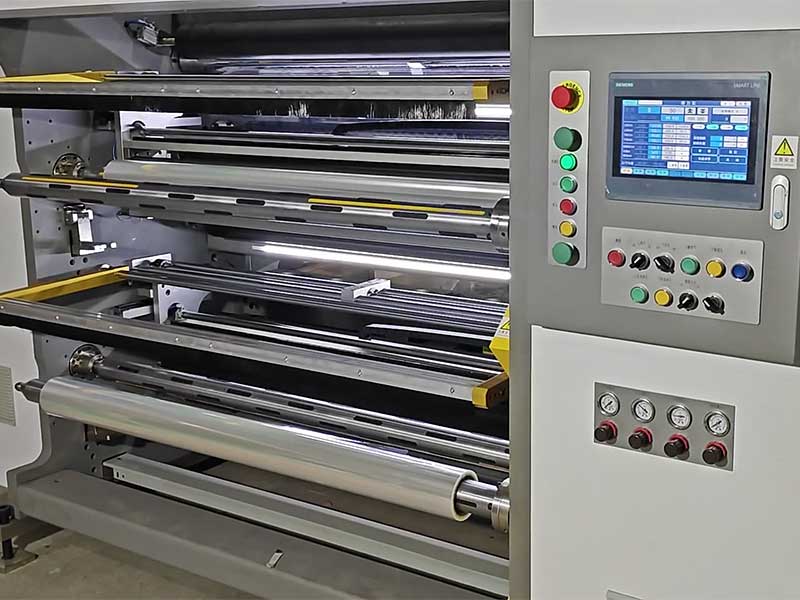
3. From Tension to Correction: A Precise Concerto
Tension control and closed-loop correction do not operate in isolation; there is a complex coupling relationship between them. Under high tension, the film surface is "taut," with good lateral stability, which is beneficial for correction, but the cut edge tends to develop stress whitening; Under low tension, the film surface is smooth, but the blade can easily "push" and deform the surface, causing edge curling.
Therefore, the optimized approach is to maintain a moderate tension of "stability but not tightness" in the cutting area of the tool. Furthermore, by introducing an online machine vision inspection system, the condition of the film edge after slitting is monitored in real time, and the data is analyzed in relation to current tension and correction parameters, forming a closed-loop optimization mechanism of "detection-feedback-adjustment." This is the future direction for high-precision slitting.
Conclusion
For solar film slitting, tension control provides stability during production, while closed-loop correction ensures the accuracy of the product path. It is precisely the synergy between these two core technologies that ensures that every meter of finished product maintains highly consistent quality after the wide mother roll is broken down into pieces. In today's pursuit of "zero-defect" production, understanding and mastering this precision system is a required course for every company hoping to produce "good films."
High-precision slitting machines protect film performance within seconds through precise control of blade, tension, and positioning in an integrated manner.
25. August, 2026This process may seem simple, but in reality, it is a high-tech step integrating precision machinery, automatic control, and materials science.
17. August, 2026In other words, for every 100 rolls of finished film, 5 to 8 rolls of value silently disappear during the slitting process.
01. July, 2026The root cause of the problem is often the same: after static charge accumulates, there is no smooth discharge channel.
23. June, 2026The following is a thorough investigation from four dimensions: tension, roll pressure, core roll, and knife cutting.
18. June, 2026


 English
 Deutsch
 Français
 Español
 Português
 日本語
日本語 русский
 한국어
한국어 عربي
عربي ภาษาไทย
 Tiếng Việt
 Italiano