
Loose winding is one of the most common quality issues in solar film slitting—loose end faces, interlayer slippage, and even the entire film roll 'collapse.' Many operators' first reaction when faced with this situation is to "increase tension," but the more they increase, the worse it gets. In fact, loose winding is rarely caused by a single factor. The following is a thorough investigation from four dimensions: tension, roll pressure, core roll, and knife cutting.
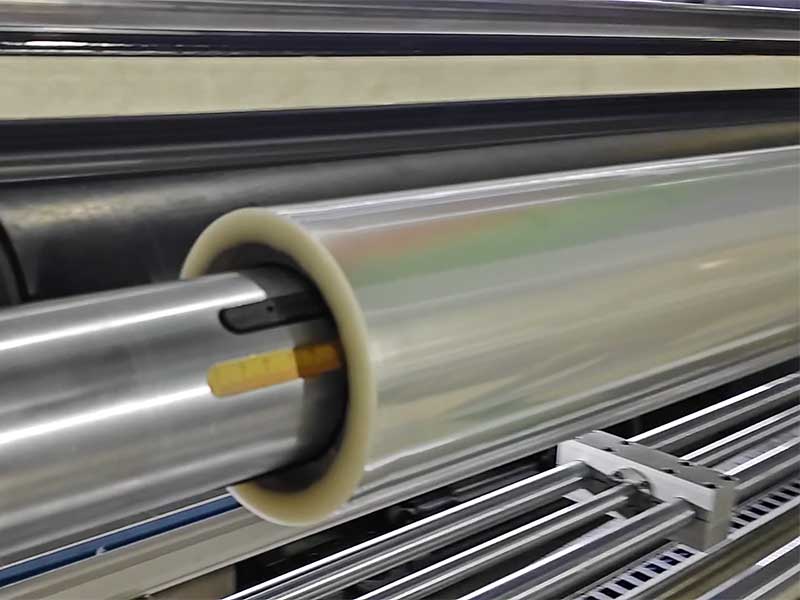
Reason 1: Improper setting of winding tension—the most common and most easily misjudged
Tension is the core control parameter for winding compaction, but the misconception that "tension means tightness" is a misconception.
Too low tension: the film surface cannot be effectively stretched, air between layers cannot be expelled, the roll is loose, and the end face expands outward in a "bell-mouth" shape.
Excessive tension: When the film is overstretched, internal stress is released after winding, causing the film roll to develop "chrysanthemum patterns" or "star-shaped" protrusions on the end face, and the inner layer becomes loose after compression deformation.
Correct method: For conventional 12μm~20μm solar film, the winding tension is generally set between 8N~15N; For explosion-proof films above 30μm, 15N~25N is recommended. Gently press the surface of the film roll being rolled with your finger—if it feels slightly elastic but not wrinkled, it's appropriate.
Additionally, the winding section should use taper tension control—gradually reduce tension as the diameter increases, preventing damage to the inner layer.
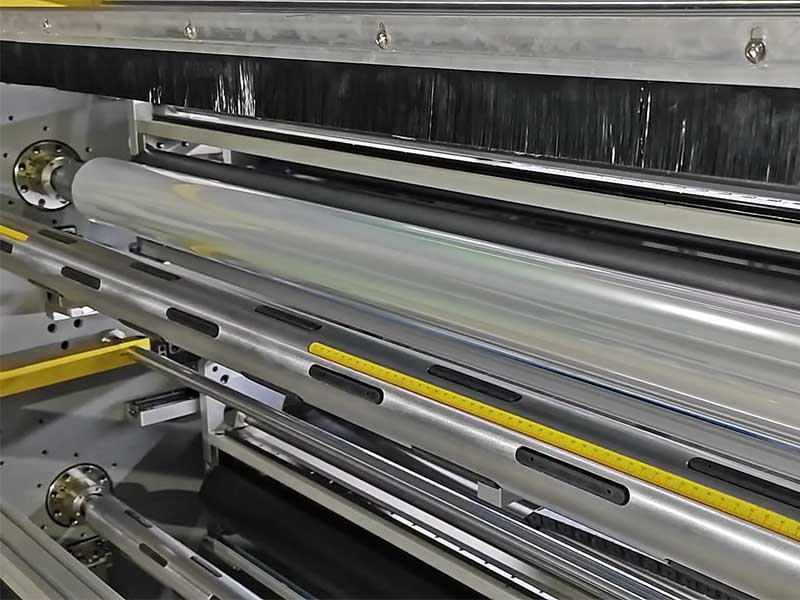
Reason 2: Abnormal status of the pressure roller (contact roller)—an easily overlooked "invisible killer"
The roller is responsible for flattening the film onto the rewinding core; if it malfunctions, no matter how precise the tension is, it's useless.
Check three key points:
1. Whether the roller surface is flat: Aging, dents, or scratches in the adhesive layer can cause uneven local pressure, resulting in "dead folds" or localized looseness on the film surface.
2. Whether the pressure at both ends is balanced: If one side is pressed tightly and the other is loose, the film will deviate toward the side with less pressure, resulting in uneven winding end faces. Use a straightedge or feeler gauge to measure the clearance between the pressure roller and the winding shaft at both ends; the deviation should not exceed 0.5mm.
3. Whether the pressure roller is parallel to the winding shaft: If not parallel, axial component forces will occur, causing diagonal wrinkles on the film surface and greatly reducing the tightness of the winding.
In actual production, some operators reported that "the winding of 4-filament CPP matte material always loosens one side," and final inspection revealed that the uneven pressure at both ends of the roller was the cause.
Reason 3: Compatibility issues between the reel and paper core—weak foundation, shaking the ground
The reel and paper core are the "foundation" of winding; if not well coordinated, tension cannot be effectively transmitted to the film.
• Deformation of paper core or uneven end face: The winding starts off not round, and with each rotation, periodic changes in tightness and tension occur, forming a "star-shaped" end face.
• Loose fit between the inner diameter of the paper core and the winding shaft: slippage causes tension fluctuations, causing interlayer slippage and loosening inside the film roll. During inspection, replacing the paper core that meets the inner diameter requirements can verify the results.
• Winding shaft bending or runout: Use a dial meter to measure radial runout; if it exceeds 0.05mm, it needs to be corrected or replaced.
Additionally, if the equipment is equipped with a slip shaft, check whether the air pressure on the slip shaft is properly adjusted—each slip ring on the slip shaft is independently controlled, and improper pressure can cause inconsistent tightness between the coils.
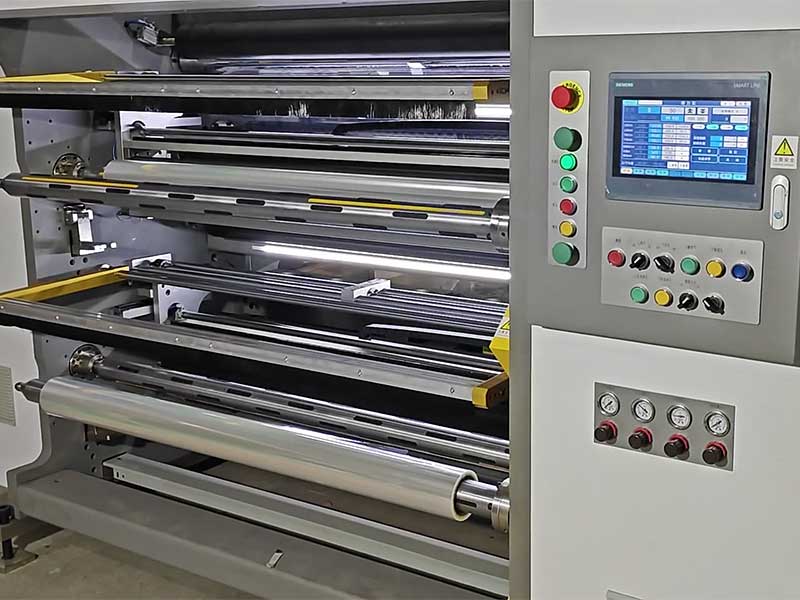
Reason 4: Poor slicing quality — poor knife cutting and tight curls
This reason is often overlooked—the quality of the slitting edge directly affects the tightness of the winding.
When the blade becomes blunt, burrs or tiny tears form at the slitting edges. During retracting, these burrs accumulate to form localized bumps, causing abnormal pressure and overall looseness at the area. Excessive knife pressure can damage the backing paper or cause the film edges to deform and wrinkle under force, which also affects the winding.
Troubleshooting method: Take a freshly cut film and hold it to light to check if the edges are smooth. If there are obvious burrs or curled edges, prioritize changing the blade or adjusting the knife pressure, then observe the improvement in the rolling.
Recommended inspection order
Follow the principle of moving from simple to complex, from outside to inside:
1. Press the surface of the film roll to make a preliminary assessment of whether the tension is appropriate
2. Low-speed idle spinning of the winding shaft, observe runout, and measure the parallelism of the pressure rolls
3. Replace the paper core for trial cutting to eliminate coil fit issues
4. Check the quality of the slitting edges and confirm the blade's condition
5. If all of the above are normal, consider mechanical fundamental issues such as guide roller bearing wear and deviation of the deviation correction system
One-sentence mnemonic: First, check the tension, then the roller; third, the mandrel; fourth, the cutter—check each one to ensure tightness and tightness without worry.
High-precision slitting machines protect film performance within seconds through precise control of blade, tension, and positioning in an integrated manner.
25. August, 2026This process may seem simple, but in reality, it is a high-tech step integrating precision machinery, automatic control, and materials science.
17. August, 2026This article will provide an in-depth analysis of the two core pillars of high-precision solar film slitting machines: tension control and closed-loop correction.
06. July, 2026In other words, for every 100 rolls of finished film, 5 to 8 rolls of value silently disappear during the slitting process.
01. July, 2026The root cause of the problem is often the same: after static charge accumulates, there is no smooth discharge channel.
23. June, 2026


 English
 Deutsch
 Français
 Español
 Português
 日本語
日本語 русский
 한국어
한국어 عربي
عربي ภาษาไทย
 Tiếng Việt
 Italiano