
In thermal transfer printing technology, the quality of the ribbon directly affects the printing effect. The industrial-grade ribbon slitting machine that accurately slits the original ribbon (master roll) of large rolls into narrow specifications required by printers is the core equipment in the production process.
This article will provide an in-depth analysis of the working principle of an industrial-grade ribbon slitting machine and take you to understand its core components through structural diagrams.
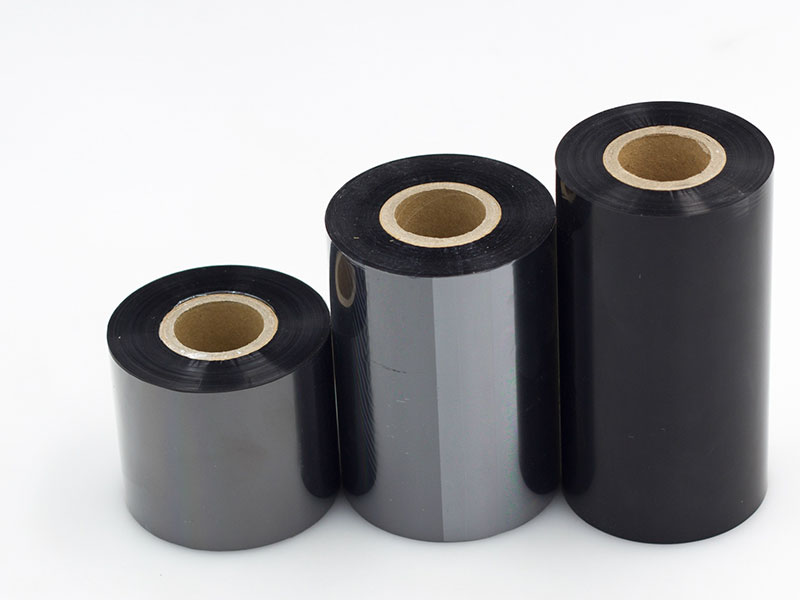
1. Overview of the working principle
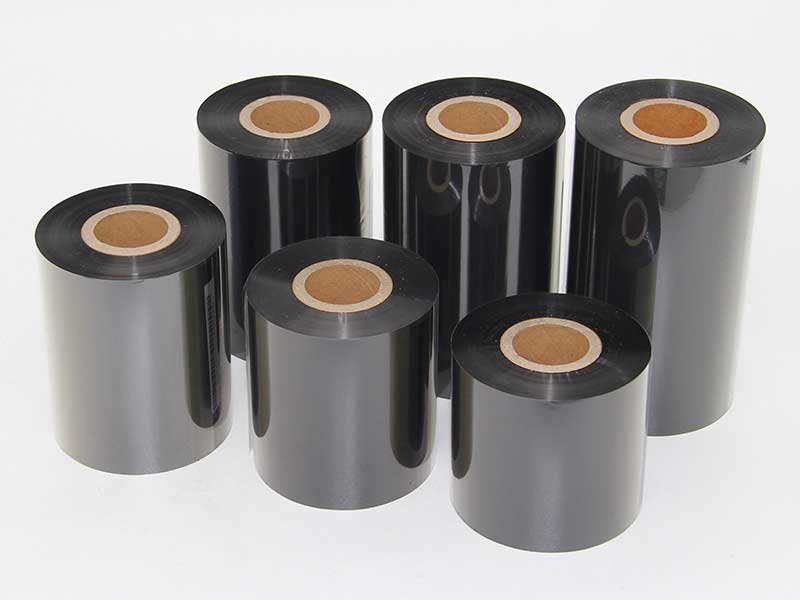
The core tasks of the industrial ribbon slitting machine can be summarized in eight words: unwinding, slitting, and winding. The basic principle is to use a sharp blade to cut a wide ribbon master roll (usually composed of a base film, heat-resistant coating, and ink layer) into multiple narrow strips along the longitudinal direction, and at the same time rewind it onto a small paper core with constant tension and speed.
Unlike regular paper or film slitting, ribbon slitting requires solving two major challenges:
1. Ultra-thin material tension control: The thickness of ribbons is usually only about 4.5 microns to 10 microns, which is very easy to stretch and deform, and must rely on sophisticated tension control systems.
2. Coating surface protection: The ribbon is divided into ink surface and back coating (heat-resistant and slippery coating), and the coating surface must be damaged or adhered to during the slitting process.
The entire workflow is as follows:
Feeding → Unwinding and correcting deviations → Feed traction → Slitting → Waste edge removal → Rewinding tension control → Rewinding
2. Core structure diagram and component function
For a more intuitive understanding, we can divide the slitting machine into the following main systems (refer to the structure diagram below):
1. Unwinding system
The unwinding system is the starting point of the slitting process.
• Function: Install and release the wide ribbon master roll.
• Core Components:
◦ Inflatable shaft: Used to fix the master coil, lock the coil through inflatable expansion to ensure that it does not slip at high speeds.
◦ Unwinding Tension Controller: Typically with a magnetic powder brake. It provides a moment in the opposite direction of operation, creating a "back pull force" that ensures that the master coil remains tight at all times when released, preventing wrinkles caused by slack.
◦ Photoelectric Correction System: This is the first level to ensure the accuracy of slitting. Since the master coil end face may be uneven, sensors such as ultrasonic or infrared detect the ribbon edge in real time and drive the slide table to move left and right, so that the ribbon entering the tool group is always in the correct position.
2. Traction and drive system
• Function: Provides forward momentum to the ribbon and controls the running speed.
• Core Components:
◦ Traction rubber roller and steel roller: The ribbon is pressed between the rubber roller and the steel roller, which is pulled at a constant speed by friction. The speed of the servo motor determines the linear speed of the whole machine (usually up to 200-300 m/min).
◦ Encoder: Real-time feedback speed signal to ensure the synchronous matching of winding speed and unwinding speed.
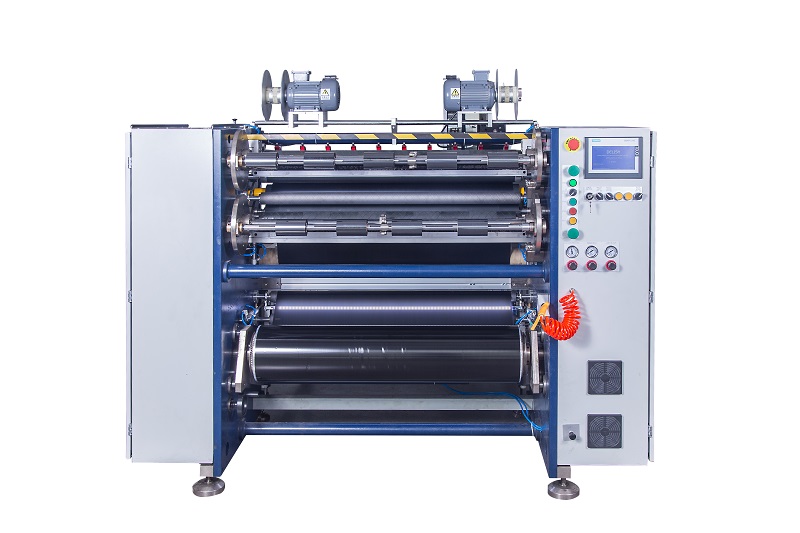
3. Slitting system (core work department)
This is a key area that determines the quality of ribbon slitting.
• Slitting method: Industrial-grade ribbons are usually cut with a disc knife or razor (cutter).
◦ Upper/lower cutter (circular cutter): The upper circular knife and the lower knife ring (active or passive) rotate in a staggered manner like scissors to cut off the ribbon. This method has a neat cut, dust-free and suitable for high-quality ribbons.
◦ Tool holder and washer: Precise control of the slitting width through different widths of washers, with an accuracy of up to ±0.1mm.
• Key Requirements: Blade sharpness and clearance adjustments are crucial. The blade must be extremely sharp and the pressure must be adjusted precisely to cut off the coating without damaging the fragile ink layer due to excessive extrusion.
4. Waste edge removal system
• Function: During the slitting process, the edges of the master roll are often of poor quality or inaccurate width, resulting in two waste edges.
• Core Components:
◦ Waste edge guide groove/air suction outlet: Generate negative pressure through a high-pressure fan to suck the cut narrow waste edge into the pipe and collect it in the waste bin. This process is continuous and avoids manual intervention.
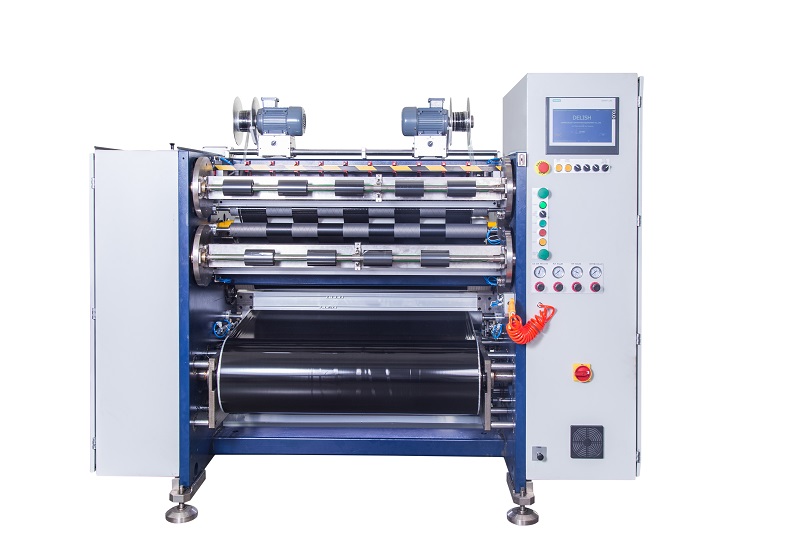
5. Winding system
The winding system determines the appearance and internal stress distribution of the finished ribbon coil.
• Function: Roll the slitted ribbons onto the small paper core.
• Core Components:
◦ Rewinding shaft: usually also an inflatable shaft, used to hold multiple small paper cores (arranged according to different widths).
◦ Rewinding tension control: Vector frequency conversion control or torque motor control. Rewinding tension typically needs to be designed as "decreasing tension" or "taper tension". Because as the coil diameter grows, if the tension remains constant, the inner ribbon will be stretched or crumpled. The control system will calculate according to the roll diameter and gradually reduce the tension to ensure that the tightness of the finished roll inside and outside is consistent.
◦ Roller: During the winding process, the roller is gently pressed on the winding core to expel air and prevent wrinkles, making the winding end face more flat.
6. Electrical control system
• Function: The brain of the entire device.
• Core components: PLC (Programmable Logic Controller) and HMI (Human-Machine Interface Touch Screen). Here the operator sets parameters such as slitting width, speed, and winding tension curve, and the system automatically coordinates the actions of each motor and brake.

3. Special design of industrial-grade equipment
Compared with ordinary stationery tape slitting machines, industrial ribbon slitting machines also have the following special designs:
1. Dust-free/low-dust design: Ribbon is highly sensitive to dust, and dust particles can cause the coating to peel off when slitting or printing. Therefore, high-end equipment usually features a closed tool bay and is equipped with an air purification interface.
2. Static Eliminator: High-speed friction generates static electricity, which not only absorbs dust but may also break down electronic components or cause electric shock to operators. The equipment is equipped with static elimination rods (ion rods) on the critical path to neutralize static electricity.
3. Hard anodized treatment: All over rollers in contact with the ribbon, the surface is sprayed with Teflon or hard anodized, the surface is smooth and hard, preventing scratching the ribbon back coating.
4. Conclusion
The industrial ribbon slitting machine is a piece of equipment that integrates precision machining, automatic control technology, and material mechanics. Its core value lies in its ability to efficiently and accurately convert wide master rolls into finished products that can be used directly in printers without damaging the micron-level coating.
Understanding the working principle of constant tension control and precision shearing, as well as the synergy between various systems, you can understand why a high-end slitting machine can determine whether a ribbon is a smooth and well-printed high-quality product, or a wrinkled and misaligned waste product.
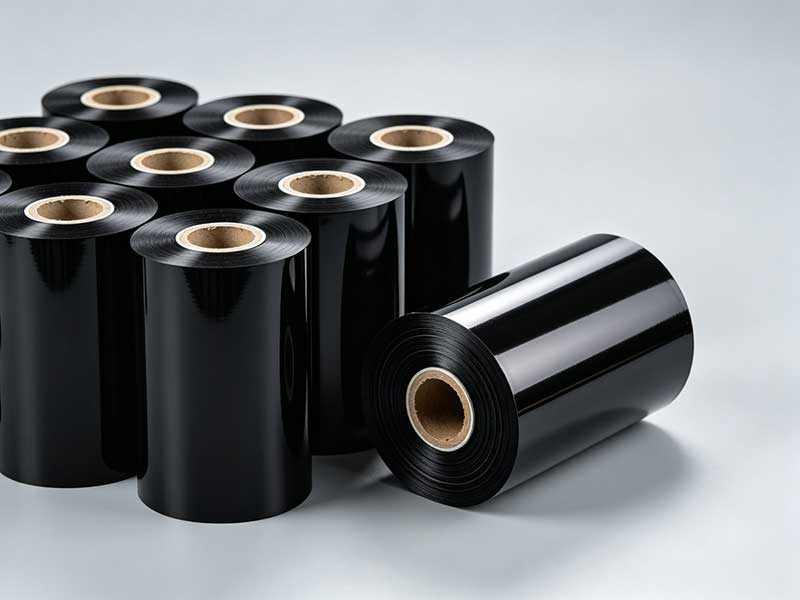
The essence of uneven end faces in ribbon slitting machines is an external manifestation of subtle imbalances between tension, parallelism, correction, and tool condition.
05. October, 2026To solve this problem, a systematic inspection is needed from four dimensions: tension control, mechanical precision, auxiliary systems, and operating standards.
05. October, 2026The first watershed in choosing a model isn't speed or brand, but rather — which type of ribbon do you mainly cut?
23. September, 2026When asking suppliers the following seven questions, the quality of the answers is far more valuable than the numbers on the parameter table.
21. September, 2026
This guide explains what buyers need to know about each parameter—not just the numbers, but the practical implications for production quality, material compatibility, and total cost of ownership.
18. September, 2026


 English
 Deutsch
 Français
 Español
 Português
 日本語
日本語 русский
 한국어
한국어 عربي
عربي ภาษาไทย
 Tiếng Việt
 Italiano