
In industries such as film packaging, electro-optics, new energy (such as lithium battery separators, photovoltaic backplates), and printing composites, PET films are widely used due to their excellent mechanical properties, heat resistance, and dimensional stability. However, the performance of the slitting machine is critical to efficiently and accurately convert wide and large PET master rolls into narrow finished products that meet the needs of downstream customers.
Choosing an unsuitable slitting machine often leads to problems such as uneven end faces, scratches, warping, winding misalignment, and even film breakage, resulting in huge material waste. So, in the face of a dazzling array of slitting equipment on the market, how to accurately select the type? This article will start with the key parameters and provide you with a detailed selection guide.
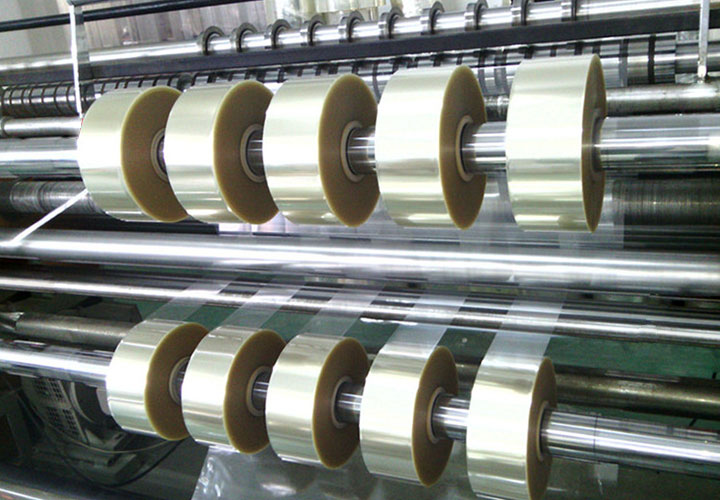
1. Clarify processing requirements: start from "material characteristics"
Before choosing equipment, first clarify the specific processing conditions of PET film. The requirements for slitting machines vary greatly for PET films for different applications:
• Thickness range: Normal packaging film (12-75 μm), optical film (50-250 μm) or thick film/sheet (> 250 μm)? The thinner the thickness, the higher the requirements for tension control and unwinding accuracy; The thicker the thickness, the higher the requirements for blade life and spindle rigidity.
• Width and roll diameter: Is the width of the master roll 1.6 meters, 2.2 meters, or more than 5 meters? Is the maximum winding diameter 400mm or 800mm? This directly determines the basic specifications of the device.
• Sensitivity: Is it a high value-added optical grade PET (no scratches, no white spots, no crystal spots required)? Is it a coated film (no adhesion and no indentation is required on the slitting end face)?
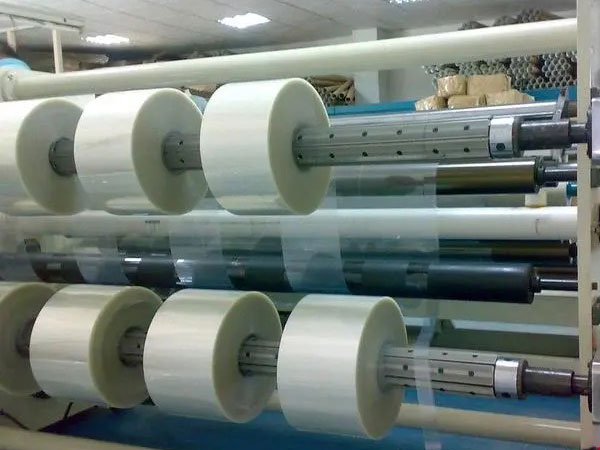
2. Detailed explanation of core key parameters
When choosing a PET film slitting machine, it is recommended to focus on the following five core parameters:
1. Tension control system
This is the core indicator of the slitting machine. PET film has high modulus and good stiffness, but once the tension is out of control, it is very easy to produce tensile deformation or "burst ribs" (too high winding hardness).
• Closed-loop tension control: Equipment with closed-loop tension control system must be selected. That is, the film tension is detected in real time by the pendulum roller or tension sensor, and the torque of the unwinding and rewinding shaft is automatically adjusted by PLC.
• Taper tension: During the winding process, the inner layer tension must decrease proportionally as the coil diameter increases (taper control). The excellent taper algorithm can ensure that the large core does not collapse and the outer layer does not strain.
2. Slitting method
There are two main ways to slitting PET film, which need to be selected according to the material thickness and quality requirements:
• Shear slitting: suitable for thin thicknesses (usually < 100μm). The upper and lower blades cut like scissors, and the cuts are smooth and fast. The blade gap needs to be precisely adjusted according to the thickness, otherwise it is easy to produce burrs.
• Press-cut (round knife/razor): suitable for thicker or antistatic, hard coating PET films. It is divided into "air knife" contact type (suitable for thin materials) and "rolling type" (suitable for thick materials). For optical grade PET, non-contact laser or ultrasonic slitting (high-end special models) is mostly used to avoid scratches caused by mechanical contact.
3. Winding method and roller mechanism
• Winding methods: Common winding methods include center winding (driven by shaft core) and center + surface winding (adding contact pressure rollers on the basis of center drive). For PET films with large roll diameters or easy slippage, it is recommended to choose "center + surface" winding, which drives air out of the film layer through a pressure roller to prevent winding slack or end face misalignment.
• Roller structure and angles: The material (rubber, PU, or wrapping hardness) and corner design of the roller directly affect the tightness and end face neatness of the winding. Slitting ultra-thin PET (< 6μm), even a special air diversion design is required.
4. Slitting accuracy and tool holder structure
• Tool holder rigidity: The precision of the tool holder's fine-tuning determines dimensional tolerances. High-end equipment is usually equipped with high-precision screws and linear guides, ensuring that the positional accuracy of each tool is within ±0.1mm.
• Tool rowing system: manual tool arrangement is inefficient and error-prone, large or high-frequency switching order slitting machines should choose automatic tool arrangement system, through the software input width parameters, the tool holder is automatically moved into place, greatly reducing the order change time.
5. Dust removal and static elimination
PET film is very prone to static electricity when running at high speeds (usually 300-600m/min, or even higher). Static electricity not only absorbs dust and causes product defects, but can even cause fires in severe cases.
• Static elimination rods: AC or pulse static eliminators must be configured at unwinding, rewinding, and critical rollers.
• Dust removal device: For high-cleanliness applications such as optical films and electronic films, the equipment should be equipped with sticky dust rollers or air knife dust removal systems to ensure that no new pollution sources are introduced during the slitting process.
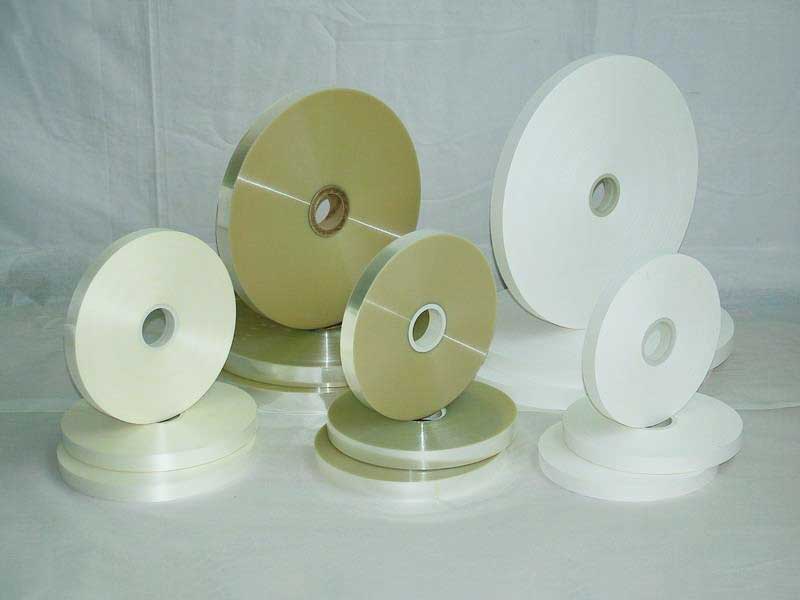
3. Guidelines for selecting and avoiding pitfalls
In actual procurement, in addition to looking at the parameter table, the following points often determine the later use experience of the equipment:
1. Equipment rigidity cannot be compromised
PET film slitting machine belongs to heavy-duty, high-speed equipment. The structure of the airframe (cast iron wall panel vs steel plate welding) determines stability at high speeds. Inferior equipment is prone to resonance after long-term high-speed operation, resulting in slitting width drift. It is recommended to inspect the processing machine (such as gantry milling) and heat treatment process of the equipment on the spot.
2. Trade-offs in the degree of automation
• Manual order change vs automatic order change: If your factory's order is characterized by "large batch size and small variety", manual order change can be satisfied; If it is "many varieties and high frequency", please be sure to invest the budget to purchase automatic winding towers (automatic turrets) and automatic tool arrangements, otherwise labor costs will become production bottlenecks.
• MES/ERP docking: The digital factory needs to confirm whether the slitting machine has a reserved data interface, and whether it can realize the automatic issuance of process parameters and the automatic return of output data.
3. Manufacturer qualification and after-sales
PET film slitting machine is a non-standard equipment with strong customization. When choosing a supplier, it is important to look not only at the price of the equipment, but also at the following
• Industry experience: Are there any successful cases of the same type (e.g., optical grade, lithium battery separator) films?
• After-sales response: Can you provide 24-hour remote guidance or on-site service within 48 hours when the equipment breaks the film or electrical fault? The slitting machine stopped for one day may cause huge losses in the supply of the back-end production line.
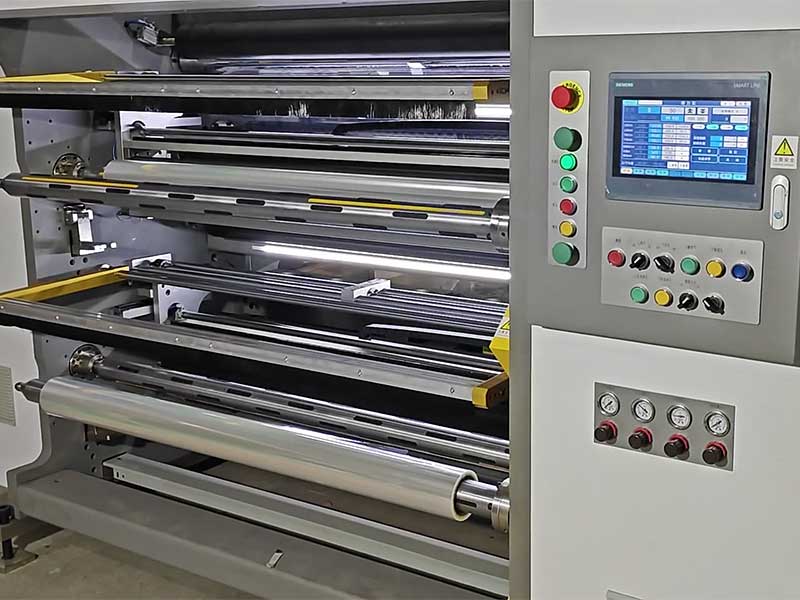
4. Summary: Three steps to select
1. Define the product: Clarify the thickness tolerance, width range, maximum master roll weight, cleanliness level, and daily output requirements of the PET film.
2. Matching Parameters: Prioritize tension control accuracy and winding quality. For high-end applications, don't omit the "closed-loop tension" and "auto-taper" features to save your budget.
3. Verification effect: Before signing the contract, it is recommended to bring your own PET master coil (especially the hard-to-cut batch) to the equipment manufacturer for trial cutting with material. Key observations:
◦ Face neatness (no serrations and no white edges in sight);
◦ Rewinding hardness (whether it is uniform, whether there is a "chrysanthemum core");
◦ Whether wrinkles caused by tension fluctuations occur during high-speed start-stop (e.g., acceleration and deceleration).
Epilogue
Choosing a PET film slitting machine is essentially choosing a "fine control" ability. A good slitting machine is not only a tool for production capacity, but also the last line of defense to ensure the yield rate of high-value PET films. We hope that the key parameter analysis and selection ideas in this article can help you make informed decisions in a complex market environment.
(Note: The specific equipment model and technical parameters are recommended to be confirmed in combination with the latest market conditions and the technical agreement provided by the supplier.) )
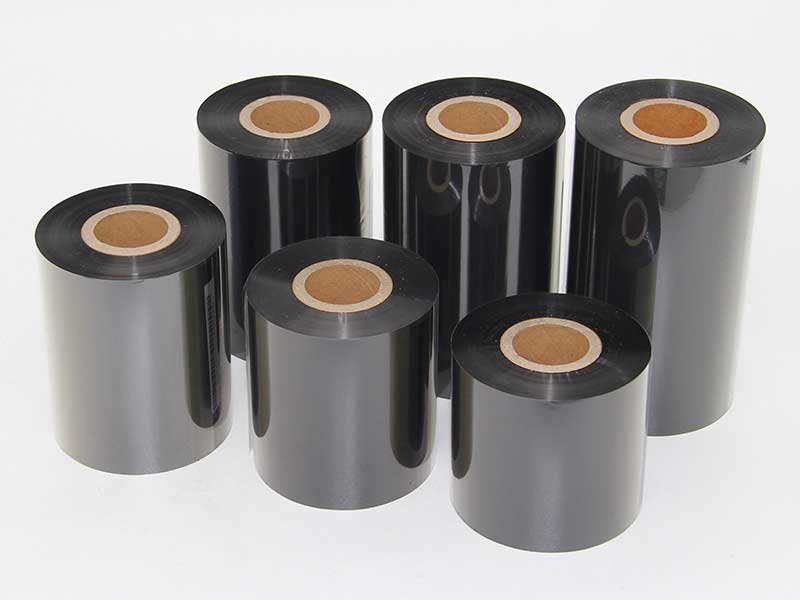
This article reviews the core considerations in selection from dimensions such as accuracy, speed, hardware configuration, flexible production adaptation, and manufacturer evaluation.
01. September, 2026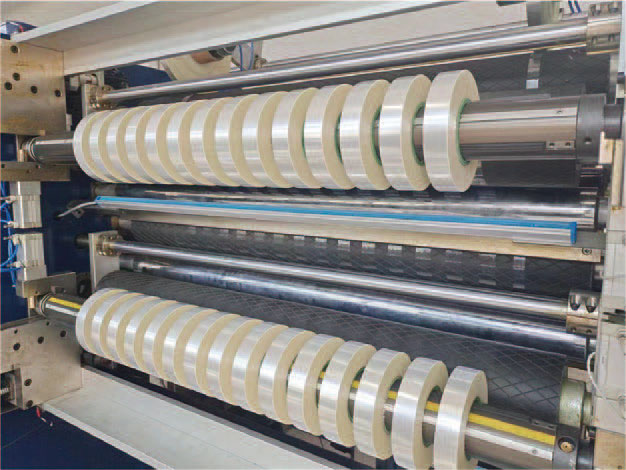
This article systematically reviews the key points for selecting a PET film slitting machine, covering core parameters, common misconceptions, and practical validation.
20. August, 2026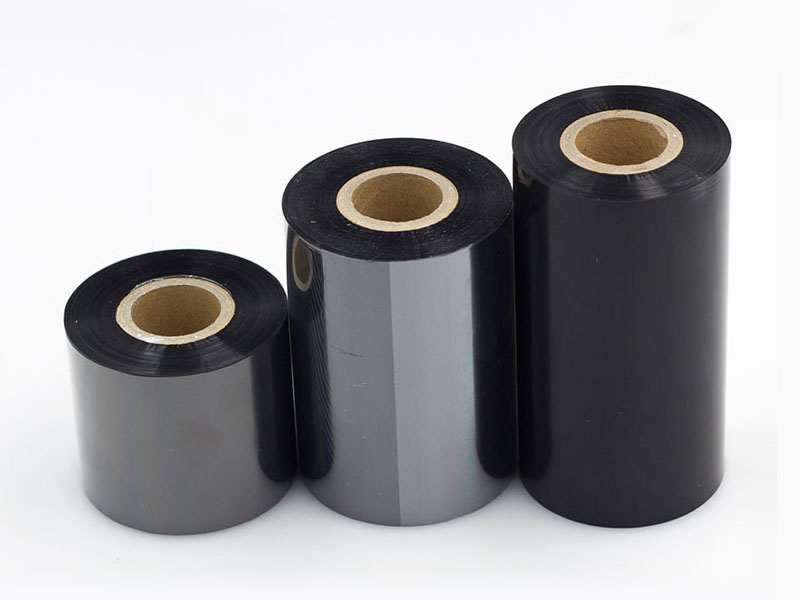
Its cut quality directly determines whether the barcode is clear, whether the print head is damaged, and whether the logistics label can flow smoothly.
19. August, 2026Faced with the dazzling array of models on the market, how can you clear away the spec fog and make wise decisions?
31. July, 2026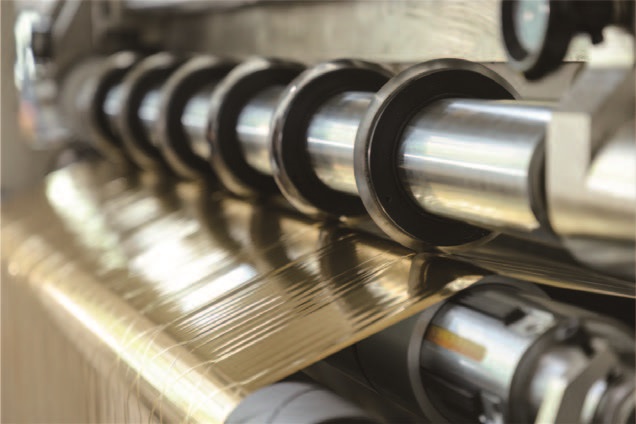
One wrong step and losing not just a roll of materials, but the quality of an entire batch of high value-added products.
23. July, 2026


 English
 Deutsch
 Français
 Español
 Português
 日本語
日本語 русский
 한국어
한국어 عربي
عربي ภาษาไทย
 Tiếng Việt
 Italiano