
In the field of thermal transfer printing, ribbon slitting accuracy directly determines the final print quality—whether the barcode is clear, the edges are neat, and whether the print head lifespan is affected. When slitting accuracy is not met, ribbons may develop burrs, width deviations, serpentine misalignment, or even coating scratches, leading to the entire roll being scrapped. To systematically solve the problem of insufficient accuracy, coordinated efforts are needed from multiple dimensions, including blade systems, tension control, correction and feeding, and equipment maintenance.
1. Blade System: The First Line of Defense for Accuracy
The blade is the executor of the slitting action, and its condition directly determines the quality of the cut. When accuracy is insufficient, the first step is to troubleshoot blade issues.
Did you choose the right blade material?
Different ribbons have significantly different requirements for the blade. Wax-based ribbons are relatively soft and can be handled by ordinary high-speed steel blades; Resin-based ribbons contain high-hardness pigments, which cause significant wear on the blades. Cemented carbide (tungsten steel) blades have a hardness of HRA 89-92, and their lifespan when slitting resin-based carbon ribbons is 5-10 times that of high-speed steel. If the spindle runout accuracy of the equipment is sufficient (≤0.005mm), cemented carbide is the optimal choice for high-end ribbon slitting; if the equipment precision is average, cemented carbide tends to chip, making high-speed steel a more stable solution.
Are the blade installation and clearance properly adjusted?
Blade installation angle deviations or improper overlap between upper and lower blades can cause uncut edges or burrs. Typically, the overlap between upper and lower blades should be controlled between 0.01-0.03mm, and the lateral clearance between 0.02-0.05mm, requiring microscope calibration. If the parallelism deviation between the tool holder and the bottom roller is off, it will cause local cutting failure—check the clearance at both ends with a dial indicator and adjust the height adjustment screw at both ends of the tool holder to fix the problem.
Have you checked blade wear regularly?
When the blade edge becomes dull, the cutting changes from "cutting" to "squeezing," causing edge stretching, deformation, and burrs. It is recommended to establish a replacement ledger for blades, replacing them regularly by meter or time, rather than waiting until obvious quality issues arise to address them.
2. Tension control: The invisible precision killer
The ribbon substrate is usually PET film with a thickness of 4.5-10μm, which is extremely sensitive to tension. If the tension is too high, the ribbon will be stretched and deformed, causing the width to shrink after slitting and resulting in inaccurate dimensions; If the tension is too low, the ribbon will loosen and drift, and the cut edges will become serpentine. Tension fluctuations are also a major trigger for coating scratches—sudden changes in speed can cause the ribbon to slip instantly on the guide roller, resulting in scratches.
Closed-loop tension control is standard, not optional
Modern high-precision slitting machines generally use three-stage independent closed-loop tension control: unwinding (magnetic powder brake) + traction (servo motor) + winding (vector variable frequency motor). Real-time feedback from tension sensors and dynamic adjustment by PLC control tension fluctuations within ±0.5N. If the equipment still uses mechanical friction plate control, upgrading to a closed-loop servo system is the best entry point for improving accuracy, the input-output ratio.
Taper tension: the key to smooth winding
As the diameter increases during winding, if the tension remains unchanged, the outer layer will tighten more and more, causing the inner layer to be crushed and ink to stick, resulting in a "chrysanthemum core" shape on the end face. Taper tension control was developed precisely for this purpose — the system automatically reduces the winding tension according to a preset curve based on real-time calculated roll diameter, ensuring consistent hardness between inner and outer layers and a mirror-like flat end face.
The tension "temper" of different ribbons
Wax-based ribbons are suitable for low tension (3-5N), mixed bases with medium tension (5-8N), and resin-based ribbons require slightly higher tension (8-12N). Different ribbon types cannot be directly copied due to tension parameters.

3. Correction and material removal: Make sure every cut is in the correct position
Even if the blade is sharp and the tension is constant, if the material is off, precision is impossible.
Correction system: prevents snake-like deviation
The high-precision slitting machine is equipped with photoelectric sensors or CCD line array cameras to scan the ribbon edge position in real time. If any offset occurs, the servo system drives the unwinder to make lateral adjustments within milliseconds, "pulling" the strip back to the correct position. The correction accuracy can reach ±0.03mm. If the narrow strip width fluctuates between slits, checking whether the correction system is functioning properly is often the first step.
The roller state is often overlooked
The surface finish, parallelism, and rotational flexibility of all rollers affect feeding stability. Roller surface scratches, adhesive residue, or bearing wear can cause uneven force on the ribbon, resulting in scratches or misalignment. Ultra-mirror aluminum guide rollers (Ra≤0.05μm) and anti-static rubber rollers are standard equipment for high-end equipment.
Static electricity: an invisible source of interference
During high-speed slitting of ribbons, static electricity is easily generated. The dust absorbed by static electricity not only contaminates the coating but also causes ribbons to stick to tools or guide rollers, causing feed misalignment. Installing static elimination rods at the unwinding, slitting, and rewinding positions and ensuring reliable grounding of the equipment (grounding resistance less than 4Ω) is a basic but necessary measure.

4. Troubleshooting methodology: What should be done when accuracy issues arise?
When slitting accuracy is abnormal, it is not recommended to blindly adjust parameters. The following order yields more efficient system troubleshooting:
1. Visual inspection: Is there a notch or obvious blunt blade? Are there scratches on the surface of the bottom roller?
2. Tactile Test: Manually turn the wheel, and feel whether the blade and the bottom roller make even and strong contact. Are the guide rollers rotating smoothly?
3. Single-point trial cutting: When the equipment is stationary, manually feed the film into the cutting edge to determine whether the entire or partial cutting is uncut — local issues are often caused by parallelism deviations or guide roller runout.
4. Parameter review: Check whether the tension set value and knife compression value are within process specifications.
5. Replace the comparison: Try cutting a new blade — this is the fastest way to eliminate blade factors.
Conclusion
Insufficient slitting accuracy of the ribbon is rarely caused by a single cause. Blade material mismatches, improper clearance adjustment, tension fluctuations, correction failures, and static interference—these issues often overlap and ultimately reflect in the quality of the finished product. Systematic inspection, establishing equipment maintenance records, and matching process parameters based on ribbon types are the three main lines for improving accuracy. As industry experience shows: prioritizing upgrading tension control systems and tool positioning systems is usually the entry point with the highest input-output ratio.
The widespread adoption of fully automatic ribbon slitting machines is changing this situation. Its core value can be summed up in six words: efficient, stable, and labor-saving.
22. October, 2026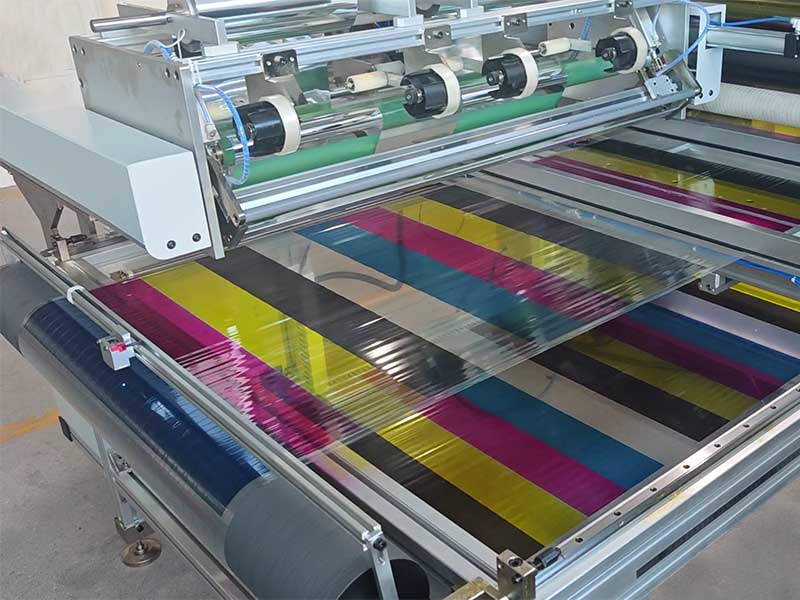
The color ribbon slitting machine is mainly used for wide roll slitting and rewinding of materials such as card printer color ribbons and thermal transfer ribbons.
21. October, 2026
This article will break down the technical core of this function from four dimensions: signal detection, control logic, shutdown strategy, and precision calibration.
19. October, 2026The value of the automatic correction function lies in incorporating this runaway variable into a precise closed loop, shifting slitting operations from "post-event selection" to "real-time self-heali
19. October, 2026This paper proposes a practical efficiency improvement plan from three dimensions: downtime management, switching optimization, and tension upgrade.
19. October, 2026


 English
 Deutsch
 Français
 Español
 Português
 日本語
日本語 русский
 한국어
한국어 عربي
عربي ภาษาไทย
 Tiếng Việt
 Italiano