
In the precision chain of modern production, the film slitting machine is an indispensable presence that seems low-key. It is not a simple "cutter" but a core device that precisely converts wide-width female rolls into specifications required for various terminal applications. From food packaging to new energy vehicles, from smartphones to solar panels, thin film slitting technology has quietly penetrated multiple pillar industries of the national economy.
1. Packaging Industry: The Dual Test of Efficiency and Precision
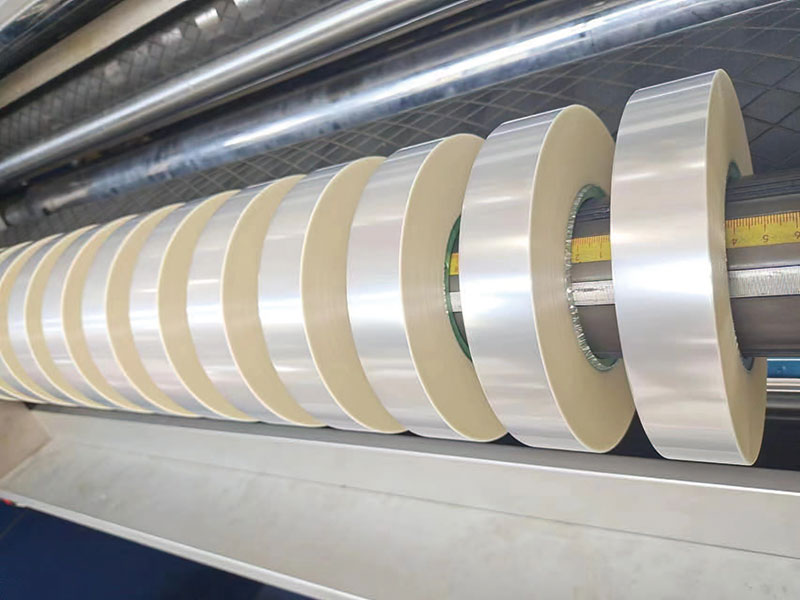
The packaging industry is the foundation for the most widely used film slitting machines. Food packaging bags, pharmaceutical aluminum foil packaging, and daily chemical product shrink films, which are commonly seen in daily life, all require a cutting process to become finished products that meet filling and packaging standards.
This application scenario presents dual challenges for equipment: on one hand, high-speed automated production lines require slitting speeds to match upstream casting or blown film production lines; On the other hand, food and drug packaging has extremely high requirements for film cleanliness and seal edge flatness. Modern slitting machines use closed-loop tension control systems and online defect detection to keep accuracy within ±0.1mm at high speeds, while ensuring a dust-free and pollution-free production environment.
2. New Energy: Supporting the Upgrading of the Clean Energy Industry
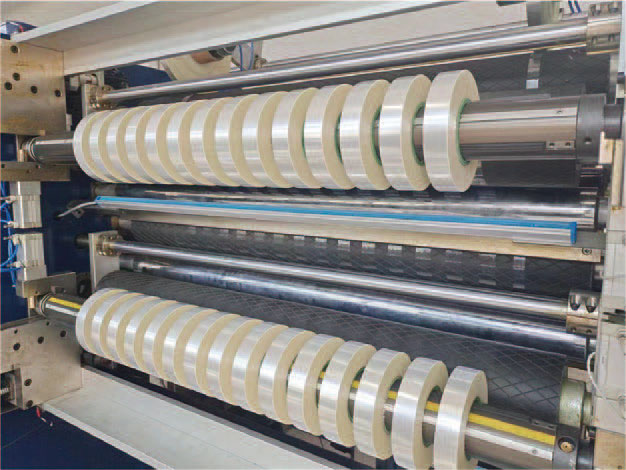
The new energy industry is the fastest-growing application field for film slitting machines, mainly reflected in two main directions:
Photovoltaic field: Solar cell backsheets and EVA/POE encapsulation films need to be precisely slitted to match the lamination process. EVA photovoltaic films are extremely sensitive to cleanliness; even tiny dust or scratches can affect module light transmittance and packaging reliability. Therefore, the slitting process usually requires a clean environment and uses special configurations such as anti-stick blades.
Lithium battery sector: As a key material for battery safety, the slitting precision of lithium battery separators directly affects the alignment and yield of internal electrode sheets. Because the separator is extremely thin (usually only a few microns to several tens of microns), the stability requirements for tension control are extremely stringent; even slight fluctuations in tension can cause the material to stretch and deform or wrinkle form.
3. Electronics and Optics: The Cornerstone of Precision Manufacturing
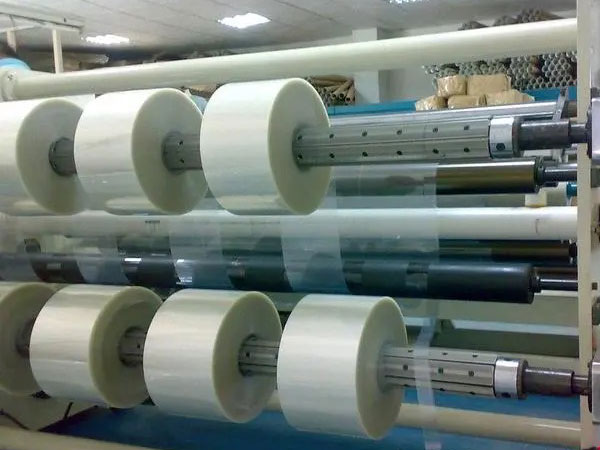
In the fields of consumer electronics and high-end optics, film slitting machines often face "high-value, high-demand" specialty functional films.
Flexible circuit board (FPC) substrates, electromagnetic shielding films, thermally conductive graphite films, and other materials require nanometer-level precision slitting in ultra-clean environments, while avoiding edge burrs or dust contamination. Optical-grade applications such as OCA optical films, polarizers, ITO conductive films, and others demand near-strict smoothness and width consistency at slitting edges. Some ultra-precision slitting equipment even integrates laser cutting technology to meet demanding requirements.
4. Medical and Health Materials: Invisible but Indispensable
The medical and hygiene products sector is another important frontier for slitting machine applications. Materials such as medical dressing substrates, breathable tapes, and pharmaceutical packaging films not only require high-precision slitting but also have special regulatory requirements for the cleanliness of the production environment and material biocompatibility. For example, EVA medical films are commonly used in pharmaceutical packaging materials and dressing substrates, where the slitting process must avoid material contamination or performance degradation.
5. From "Standardization" to "Customization"
The expansion of film slitting machine applications reflects the deep demand of downstream industries to shift from "extensive processing" to "precision manufacturing." Different fields have distinct demands for slitting equipment: the packaging industry pursues a balance between efficiency and cost, the new energy sector values tension stability and cleanliness, the electronics industry demands precision and reliability, and the medical industry strictly adheres to compliance and safety.
Against this backdrop, customized slitting solutions are becoming the industry mainstream. Equipment manufacturers need to provide modular configuration solutions based on core elements such as material characteristics, precision grades, and automation levels to meet the differentiated needs of various industries. In the future, with the integration of artificial intelligence and machine vision technologies, slitting equipment will have adaptive adjustment capabilities, further expanding its application boundaries in the field of new materials.
This article outlines a clear selection approach from four dimensions: material adaptation, core technical parameters, efficiency and cost, and supplier selection.
09. September, 2026Balancing speed and precision in film slitting machines is essentially a test of "control capability."
02. September, 2026This article will delve into the current application status, core technologies, and development trends of this equipment in the new energy sector.
28. August, 2026the film slitting machine is the core equipment for slicing wide, large rolls into narrow rolls of specific specifications.
26. August, 2026Tension control technology for thin film slitting machines involves interdisciplinary integration of control theory, mechanical design, and material mechanics.
26. August, 2026


 English
 Deutsch
 Français
 Español
 Português
 日本語
日本語 русский
 한국어
한국어 عربي
عربي ภาษาไทย
 Tiếng Việt
 Italiano