
1. First fold out the upper knife, adjust to the required size and put it back into the lower knife, and then adjust the upper knife adjustment button to the middle position.
2. Put the upper knife holder gently to the appropriate position to lock the fixed handle, push the upper knife until the lower knife is leaning, then lock it, and then adjust the upper knife pressure knob to make it pressurous.
3. Put the material to be slitted into the feeding shaft and fix (the tightness should be suitable) to pass the material through the transmission shaft, the pressure wheel, through up and down, turn the hand runner to bring it out, and at the same time adjust the left and right adjustment buttons to make it accurate, and then paste it to the roll out shaft to the paper tube, paying special attention to the specifications of the paper cylinder must be consistent.
4. Turn on the power supply and counter switch, and adjust the reel voltage to 5V (normally maintained at 5V, can also be adjusted according to the appropriate situation)
5. Measure, press the clear button to reset the counter to zero, P1 on the meter is fast, P2 is slow, P1 is 5 less than P2 value when setting, after the value is set, the LED begins to flash, about 3 seconds or so no longer flashing, indicating that the setting is complete.
6. Start the slitting button and adjust the slitting speed knob.
7. After the slitting is completed, clean up the residual glue on the upper and lower knives and transmission wheels in time to keep the equipment clean.
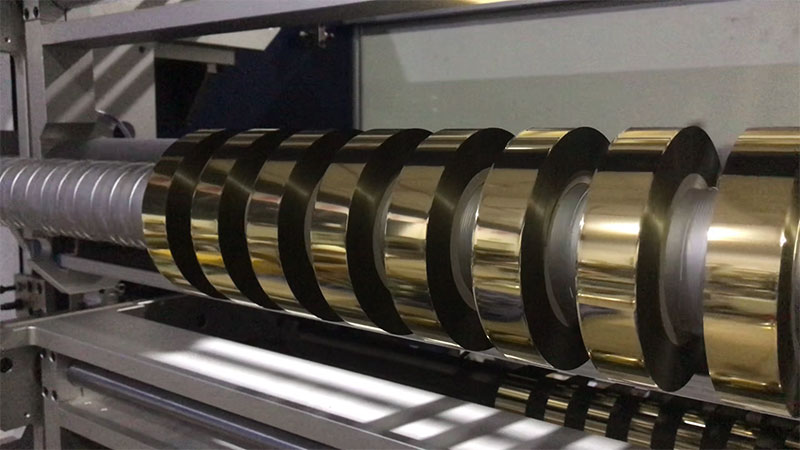
The tension control in the slitting stage directly determines the yield rate of subsequent hot stamping processes.
28. September, 2026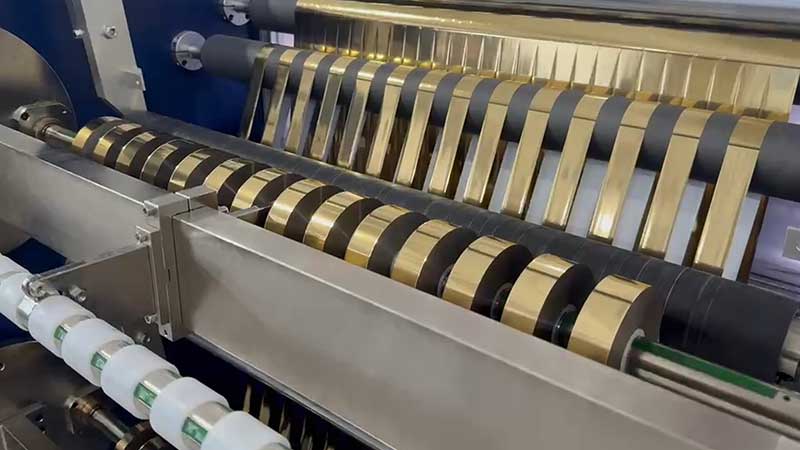
The key to selection is to grasp three parameters that truly determine slitting quality: slitting accuracy, tension control, and tool system.
28. September, 2026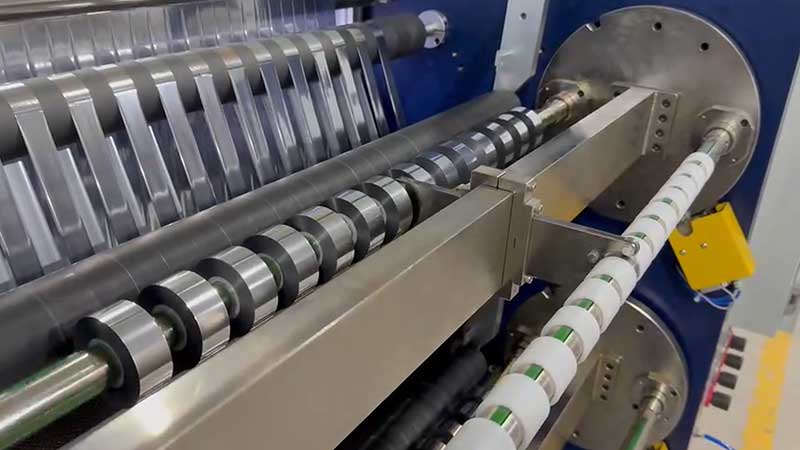
But what truly determines whether a slitting machine is "in sync" is not the absolute value of a single parameter, but the matching logic between width and speed.
28. September, 2026Width determines the rigidity and correction accuracy of the equipment's structure, while speed tests the real-time responsiveness of tension control.
24. September, 2026This article provides a current selection framework from four dimensions: material adaptation, core parameters, intelligent configuration, and cost evaluation.
24. September, 2026


 English
 Deutsch
 Français
 Español
 Português
 日本語
日本語 русский
 한국어
한국어 عربي
عربي ภาษาไทย
 Tiếng Việt
 Italiano