
The automatic guiding system of the film slitting machine (also known as the EPC system, Edge Position Control) ensures that the material is always in the correct position during the slitting process by detecting and adjusting the position of the film edge in real time, avoiding mistracking or cutting errors. How it works can be broken down into the following key parts:
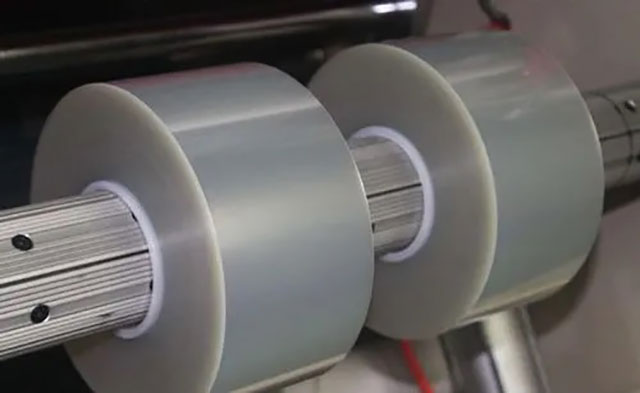
1. Edge detection sensor
• Sensor type: Commonly used photoelectric sensors (infrared or laser), ultrasonic sensors or CCD vision systems.
◦ Photoelectric sensor: Detects changes in the intensity of reflected light at the edge of the film by emitting a beam of light to determine the position of the edge.
◦ CCD vision system: high-precision camera captures edge images, suitable for complex materials or high-precision needs.
• Installation location: Usually located near the entrance of the slitter or the knife holder, real-time monitoring of the transverse position of the film.
2. Signal processing and control unit
• The sensor converts the edge position signal into an electrical signal and transmits it to a PLC or dedicated controller.
• The controller compares the heartbeat to the preset position and calculates the offset and direction (left/right).
• Generate correction instructions based on algorithms (e.g., PID control) to drive actuator actions.
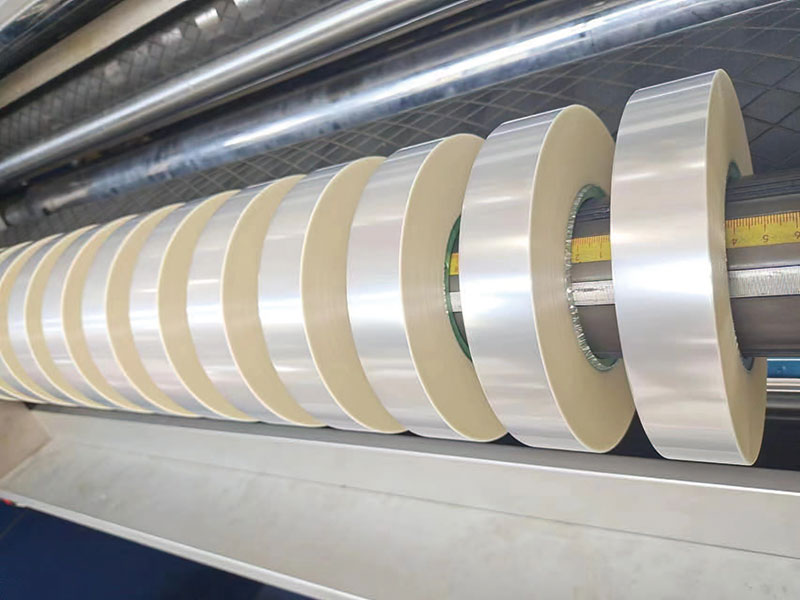
3. Correction and execution mechanism
• Correction method:
◦ Gas-liquid translation: The correction roller is pushed to move laterally through the pneumatic cylinder or hydraulic cylinder to adjust the film path.
◦ Electric lead screw: Servo motor drives ball screw to achieve high-precision displacement.
◦ Swing arm guide: Rotate the angle of the guide roller to change the direction of the film.
• Response speed: Usually it needs to be adjusted within milliseconds to adapt to high-speed slitting (such as more than 1000m/min).
4. Closed-loop feedback system
• The system continuously monitors the correction effect to form a closed-loop control:
◦ If the film is still not aligned, the controller adjusts further until the error reaches zero.
◦ Dynamically adapts to disturbances such as material tension changes, uneven thickness, or mechanical vibrations.
5. Human-Computer Interaction (HMI)
• The operator screen can set the deviation correction parameters (such as sensitivity, target position), display real-time offset and alarm information.
Key Benefits:
• High precision: the guiding accuracy can reach ±0.1mm or even higher.
• Adaptive: Compatible with different materials (e.g. PE, BOPP, aluminum foil) and width.
• Reduced waste: Avoid edge scrap or rejects due to mistracking.
Typical application scenarios
• Slitting machine, coating machine, printing machine and other continuous coil processing equipment.
• Areas that require high edge uniformity (e.g., lithium battery separators, packaging films).
Through the above synergistic work, the automatic web guiding system significantly improves the stability and production efficiency of film slitting.
This article outlines a clear selection approach from four dimensions: material adaptation, core technical parameters, efficiency and cost, and supplier selection.
09. September, 2026Balancing speed and precision in film slitting machines is essentially a test of "control capability."
02. September, 2026This article will delve into the current application status, core technologies, and development trends of this equipment in the new energy sector.
28. August, 2026the film slitting machine is the core equipment for slicing wide, large rolls into narrow rolls of specific specifications.
26. August, 2026
Tension control technology for thin film slitting machines involves interdisciplinary integration of control theory, mechanical design, and material mechanics.
26. August, 2026


 English
 Deutsch
 Français
 Español
 Português
 日本語
日本語 русский
 한국어
한국어 عربي
عربي ภาษาไทย
 Tiếng Việt
 Italiano