
In the automotive aftermarket, solar film (thermal insulation film, invisible car jacket) is no longer a simple dyed plastic sheet, but a multi-layer composite functional material. A high-quality solar film is usually composed of up to 7-9 layers of wear-resistant layers, metal insulation layers, substrate layers, mounting adhesive layers, etc., and the damage of any functional layer will lead to the scrapping of the entire roll of film.
In the production process of solar film, slitting is the final step in cutting the large coil master film to fit the window specifications of different car models. However, mechanical stress, knife edge friction and electrostatic adsorption during the slitting process often become the "high-risk link" of coating damage. How to make sharp slitting equipment "gentle"? This article will discuss the core strategies of solar film slitting machines to avoid coating damage from the perspective of equipment configuration and process control.
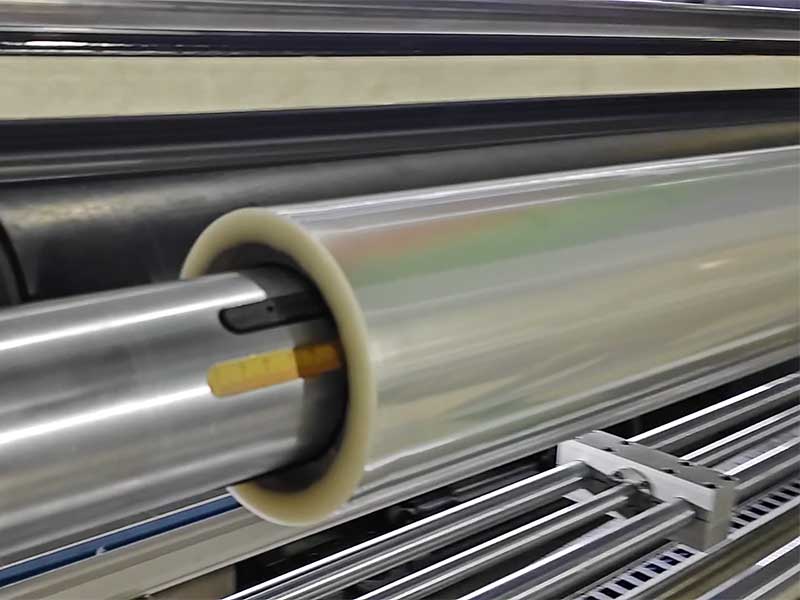
1. Root cause analysis: the "three main culprits" of coating damage
Before we explore solutions, we need to understand how the coating is injured during slitting:
1. Physical scratches and indentations: Hard friction between the film surface and the roller, or interlayer extrusion due to excessive winding tension, causes the back of the upper film to form "indentations" or "transfers" to the functional coating of the lower layer.
2. Chip dust adhesion: When cutting at high speeds, the slitting knife produces tiny dust (debris) that if adsorbed on the film surface and rolled into the finished roll, will wear down the coating during subsequent transportation or unwinding like "sandpaper".
3. Electrostatic Damage: High-speed stripping during slitting can generate high-voltage static electricity. Static electricity not only adsorbs dust, but severe electrostatic breakdown can even affect the molecular arrangement inside the coating, leading to optical distortion or performance degradation.
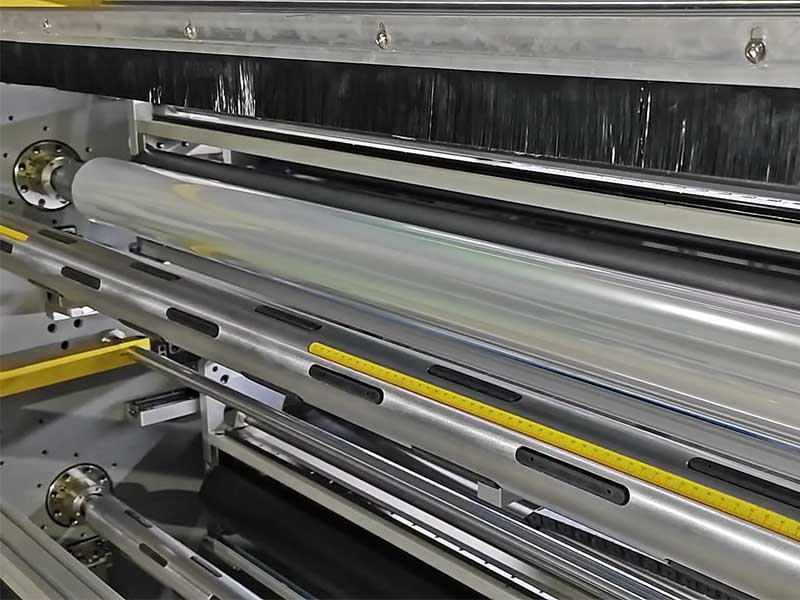
2. Hardware design: the "harmless" gene of the slitting machine
To avoid coating damage, it first depends on the design accuracy and material selection of the slitting equipment itself.
1. Over-roll surface treatment: reduce friction on the contact surface
Coating damage often comes from contact. Modern high-end solar film slitting machine is extremely particular about the design of the over-roller:
• Smooth rollers and anti-stick rollers: For the over-rollers in contact with the coating, high-precision mirror polishing rollers must be used to reduce the friction coefficient. At the same time, for the over-rollers in contact with the adhesive layer (mounting layer), anti-stick treatment (such as Teflon coating or silicone spraying) should be used to prevent deformation caused by residual pulling of the adhesive layer.
• Hardness and material of rubber rollers: Rubber rollers are usually used for traction pressure rollers, and if the rubber hardness is too high or the antistatic resistance is poor, it is easy to crush the coating. For solar films, polyurethane rubber with medium hardness (60-70A Shore hardness) and conductive properties is usually selected, which can provide sufficient friction without causing impact to the fragile insulation layer.
2. Selection of slitting methods: from "hard cut" to "soft cut"
• Circular knife shearing vs. extrusion knife: For solar films, especially hard-coated films with metal or ceramic insulation, traditional razor-blade extrusion cutting is prone to coating chipping. Upper and lower disc scissors (shear slitting) are a better choice, as they cut through material like scissors, with neater cuts and less impact on the coating.
• Ultrasonic-assisted slitting (high-end applications): Some advanced equipment introduces ultrasonic vibrating knives when cutting invisible coats on TPU substrates. High-frequency micro-vibration makes the cutting resistance almost zero, which can minimize the overflow of the adhesive layer and the chipping of the coating.
3. Micro-clearance control of the knife slot roller
When using the lower slot with the upper round knife slitting, the accuracy of the groove clearance is crucial. If the gap is too large, the film will shake or dent at the cutting point, causing the tip of the knife to scratch the lower layer; Modern equipment must have a micron-level clearance adjustment mechanism to ensure that the knife edge cuts exactly into the groove without touching the bottom.
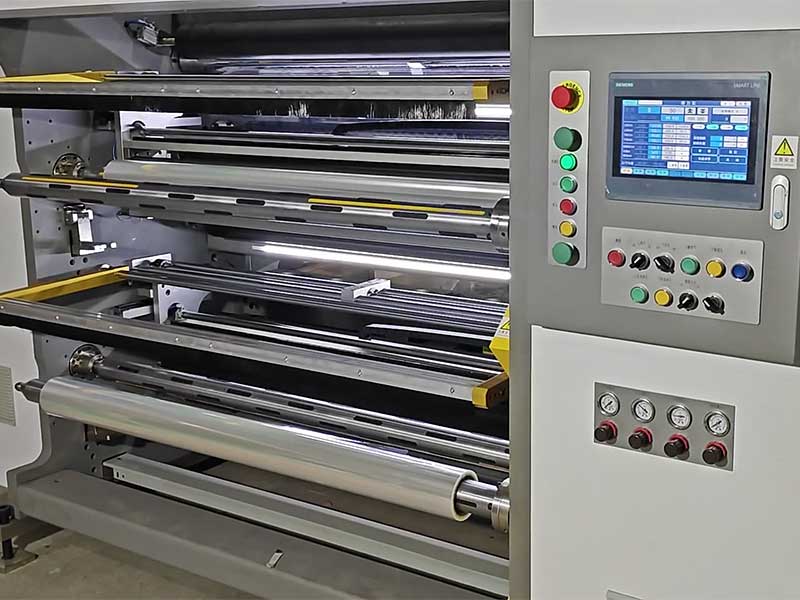
3. Process control: balance between tension and path
With good hardware, fine process parameters are also needed to match.
1. Low tension control technology
The biggest misunderstanding of solar film slitting is that "the tighter the contraction, the better". Excessive winding tension can lead to interlayer extrusion, causing plastic deformation of the inner coating.
• Taper tension control: Declining tension (taper tension) is used for winding, that is, the tension gradually decreases as the coil diameter increases. This ensures that the inner layer is tight and the outside is loose, and the inner layer is not damaged by the extrusion of the outer layer.
• Isolation layer assistance: For extremely sensitive metal or highly reflective films, a protective film (lamination) or release paper is often applied during slitting to ensure that the coating does not directly touch the back-pressure roller or the back of the lower film.
2. Static elimination system
Static electricity is an invisible killer of coating damage. A complete electrostatic control scheme should include:
• Passive static elimination rods: installed before and after unwinding.
• Electrostatic generator/ion fan: forcibly neutralizes the charge near the peeling point of the film surface.
• Ambient humidity control: Keep the humidity in the workshop at about 50%-60%, which helps to naturally release static electricity.
3. Dusting and cleaning
In order not to harm the "garbage" generated by slitting, it is necessary to have an efficient dust removal system.
• Contact dust removal roller: set up a sticking dust roller before and after slitting to stick the dust generated by the knife edge.
• Vacuum suction: Set up a micro-suction air outlet near the tool holder to suck up the drifting chips as soon as possible.
4. Conclusion
The protection of coatings by solar film slitting machines is essentially a "game of precision". It requires the ultimate mechanical stability, flexible tension control and zero tolerance for electrostatic dust.
For solar film processing companies, investing in a slitting machine with the above characteristics not only reduces the scrap rate, but also protects the value of upstream expensive coating materials. After all, only when the final level of cutting is "unscathed", the solar film that condenses countless technological contents can truly realize its value on the car window.
High-precision slitting machines protect film performance within seconds through precise control of blade, tension, and positioning in an integrated manner.
25. August, 2026This process may seem simple, but in reality, it is a high-tech step integrating precision machinery, automatic control, and materials science.
17. August, 2026This article will provide an in-depth analysis of the two core pillars of high-precision solar film slitting machines: tension control and closed-loop correction.
06. July, 2026In other words, for every 100 rolls of finished film, 5 to 8 rolls of value silently disappear during the slitting process.
01. July, 2026The root cause of the problem is often the same: after static charge accumulates, there is no smooth discharge channel.
23. June, 2026


 English
 Deutsch
 Français
 Español
 Português
 日本語
日本語 русский
 한국어
한국어 عربي
عربي ภาษาไทย
 Tiếng Việt
 Italiano