
In the field of functional film processing such as automotive solar film and building insulation film, slitting accuracy has always been the core indicator for evaluating equipment performance. Recently, with the implementation of the new generation solar film slitting machine technology, the industry's overall slitting accuracy has achieved a leap of up to 40%. Behind this breakthrough lies the following three core technological innovations.
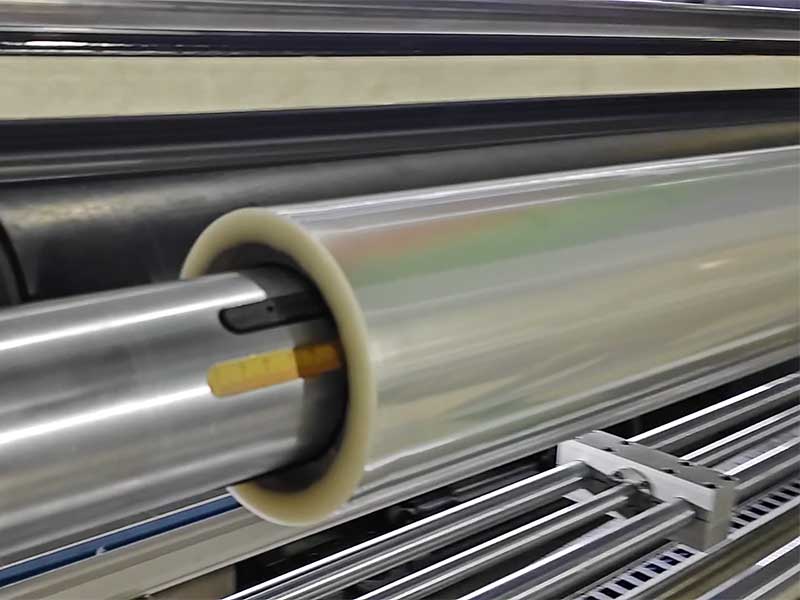
Breakthrough One: Intelligent Tension Control System—From "Rough Adjustment" to "Micron-Level Dynamic Compensation"
Traditional slitting machines generally use open-loop or simple closed-loop tension control, which is affected by factors such as changes in film roll diameter and material thickness. Tension fluctuations often lead to edge sawing, stretching deformation, and other issues.
The new generation slitting machine introduces a fully closed-loop intelligent tension control algorithm, combined with a high-resolution tension sensor (accuracy up to 0.1N) and a high-speed servo motor, achieving the following upgrades:
• Real-time dynamic compensation: The system collects tensile data hundreds of times per second and automatically adjusts the torque output for unwinding, traction, and rewinding stages based on changes in film roll diameter, keeping tension fluctuations within ±0.5N.
• Material adaptation: Built-in tension characteristic database of commonly used solar films (metal film, ceramic film, dyed film, etc.), allows one-click access to optimal parameters during material replacement, avoiding errors caused by manual experience.
• Low-speed start-stop without impact: To address tension spikes at the moment of start-stop, a slow start-stop algorithm is used to effectively prevent "horizontal lines" or "wrinkles" on the membrane surface.
Actual tests show that the new system can reduce the uniformity deviation of the slitting end face from the original 0.15mm to below 0.08mm, laying the crucial foundation for improving accuracy.
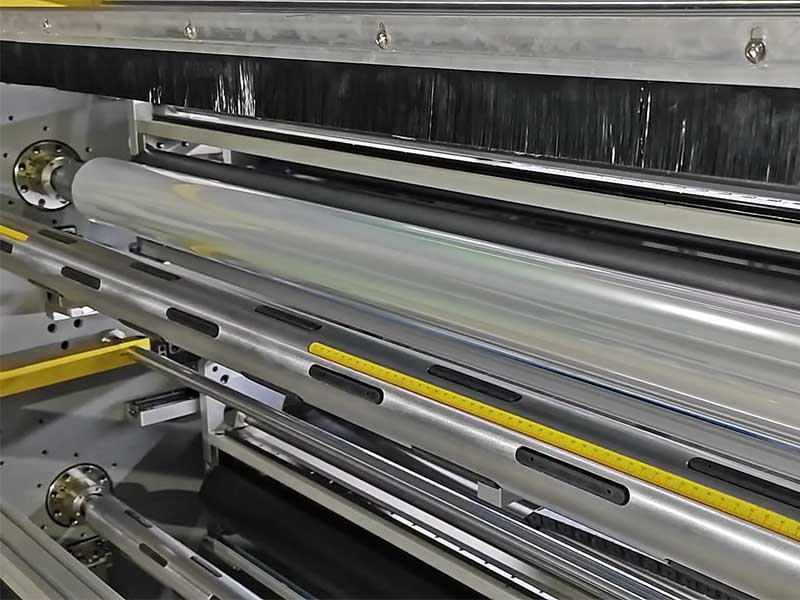
Breakthrough Two: High-rigidity tool shaft and micro-clearance adjustment mechanism—eliminating "cutting edge" and "burrs"
Another bottleneck in slitting accuracy lies in the rigidity of the tool shaft system and the ability to control blade clearance. In older equipment, when slitting at high speeds, thick films, or high-hardness films (such as safety films), the blade shaft tends to bend elastically (the "cutting knife yield" phenomenon), causing burrs or white edges to appear on the edges after slitting.
To address this issue, the new technology adopts a three-point support high-rigidity tool shaft and an electric micron-level gap adjustment system:
• Increased shaft rigidity: By increasing shaft diameter, shortening bearing span, and using alloy steel quenching and tempering, the blade shaft's bending rigidity is improved by about 60%. Even with multilayer composite films with a total slitting thickness of 0.5mm, vertical cuts can be maintained.
• Automatic clearance calibration: The engagement amount and lateral clearance between the upper (round blade) and lower (bottom blade) were previously manually adjusted by technicians' feeler gauges, resulting in large errors and complicated procedures. The new system uses servo motors to drive the eccentric sleeve mechanism, allowing the gap to be precisely controlled online within the ±2μm range, and automatically recording each slitting parameter.
• Anti-shake design: Includes a tool holder damping device to suppress high-frequency micro-vibrations during high-speed operation, preventing wavy edges.
Measured data shows that after adopting the new blade shaft system, the burr height at the edge of the solar film slitting is reduced by 65%, and the end surface finish reaches Ra ≤ 0.8μm, directly meeting the stringent requirements for "no tactile burrs" at the edges of high-end automotive films.
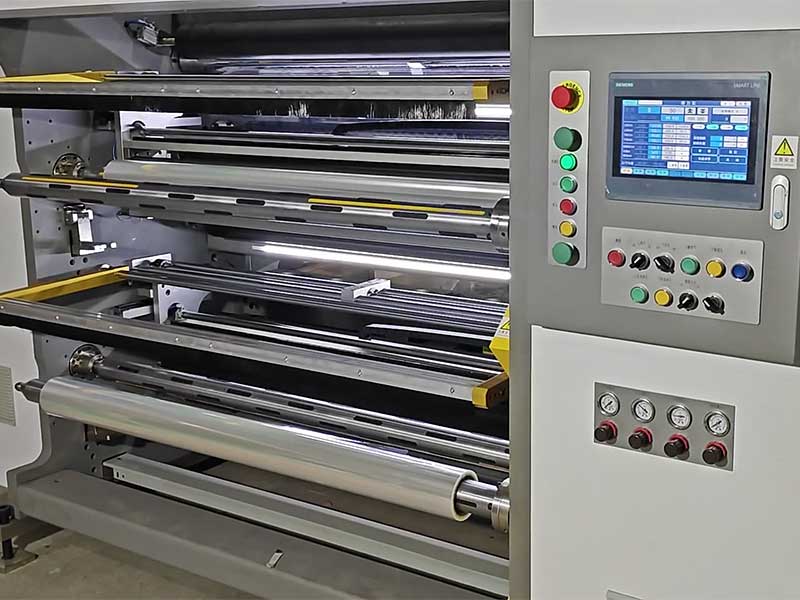
Breakthrough 3: Online Detection and Closed-Loop Correction Based on Machine Vision—From 'Post-Inspection' to 'Real-Time Correction'
Previously, dimensional deviations during slitting often had to wait until the entire roll was cut and unloaded before quality inspectors conducted spot checks, which caused a large amount of scrap. The third major breakthrough of the new technology is integrating high-speed machine vision systems with the slitting machine's correction and servo control systems, forming a closed-loop feedback.
• High-precision line scanning cameras: Industrial line array cameras are installed along the path after slitting and before winding, capturing the edge coordinates of each slitting strip in real time at tens of thousands of scans per second, with detection accuracy up to 0.02mm.
• Intelligent Defect Detection: AI algorithms can simultaneously identify appearance defects such as edge cracking, coating peeling, and film surface scratches, and automatically mark their locations.
• Real-time correction linkage: When the vision system detects that the width of a slitting belt exceeds the set tolerance, it immediately sends a fine-tuning command to the corresponding tool holder servo motor, completing slight offset compensation for the blade position within 0.3 seconds. At the same time, the winding mechanism uses an independent servo drive to prevent tape deviation caused by uneven winding force.
The introduction of this closed-loop system reduces the total width error of the entire roll slitting (from the band head to the tail) from the original ± 0.5mm to within ±0.3mm, and the defect rate is reduced by about 30%.
Conclusion: Comprehensive benefits brought by improved precision
These three major breakthroughs—intelligent tension control, high-rigidity blade shaft and micro-clearance adjustment, and visual closed-loop correction—are not isolated but deeply integrated to form a highly collaborative slitting solution. Achieving a 40% improvement in precision ultimately means:
• Improved material utilization: The width of slitting waste edges can be further narrowed, increasing the effective finished product length per roll of solar film by 5%~8%.
• Simplified post-processing: High-precision edge trimming reduces the need for secondary processing such as grinding and finishing.
• Increased brand premium: Stable edge quality has become a key factor for sun film brands when choosing OEM factories.
It is foreseeable that with the gradual popularization of these three major technologies, solar film slitting will officially enter the "micron-level precision era," driving the entire functional film processing industry toward greater efficiency and precision.
High-precision slitting machines protect film performance within seconds through precise control of blade, tension, and positioning in an integrated manner.
25. August, 2026This process may seem simple, but in reality, it is a high-tech step integrating precision machinery, automatic control, and materials science.
17. August, 2026This article will provide an in-depth analysis of the two core pillars of high-precision solar film slitting machines: tension control and closed-loop correction.
06. July, 2026In other words, for every 100 rolls of finished film, 5 to 8 rolls of value silently disappear during the slitting process.
01. July, 2026The root cause of the problem is often the same: after static charge accumulates, there is no smooth discharge channel.
23. June, 2026


 English
 Deutsch
 Français
 Español
 Português
 日本語
日本語 русский
 한국어
한국어 عربي
عربي ภาษาไทย
 Tiếng Việt
 Italiano