
In industries such as packaging, printing, electronics, and automotive, single sided adhesive (such as masking paper, BOPP adhesive, single sided versions of double-sided adhesive, protective films, etc.) is widely used. The single sided rubber slitting machine, as the core equipment for processing large roll master rolls into finished coils of the required specifications, directly affects production efficiency, product quality, and operating costs.
Faced with the dazzling array of slitting machine models and brands on the market, how can you choose the one that best suits your production needs? The following five key points deserve special attention.
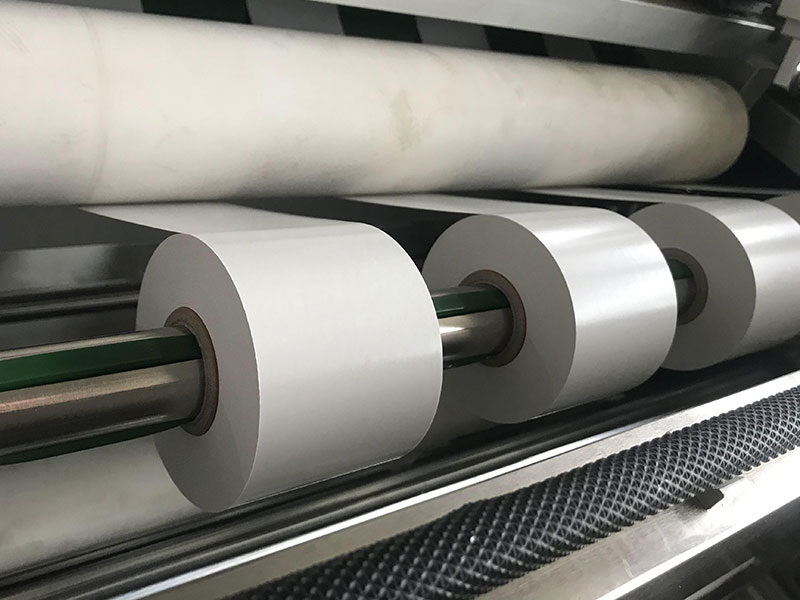
Key Point 1: Clarify the characteristics of the slitting material
Different single sided adhesives vary greatly in substrate, layer thickness, viscosity, and stretchability, and the requirements for slitting machines also vary.
• Standard BOPP carton sealing adhesive: requires moderate slitting accuracy but high speed and production efficiency, suitable for high-speed automatic slitting machines.
• Masking paper / washi adhesive: The paper substrate breaks easily and must have guaranteed temperature resistance. The slitting machine must have extremely stable tension control, and the reel must be paired with a soft start or low-tension control system.
• single sided protective film adhesive: extremely thin material, prone to static electricity and bubbles, requires anti-static devices, low-adhesion winding function, and shaftless winding structure.
• Special industrial adhesive (such as polyimide, conductive adhesive): high value, extremely narrow width, requiring very high flatness and width tolerances at the slitting ends. It is recommended to use circular blade slitting or high-precision flat blade slitting machines.
Selection recommendation: First, list all types of adhesive you need to slit, focusing on the thinnest, narrowest, stickiest, or most deformable materials to use as a basis for evaluating the basic performance of the equipment.
Key Point 2: Evaluate slitting accuracy and tolerance control
Slitting precision directly determines whether the finished product meets customer usage requirements. Accuracy typically includes two dimensions:
• Width tolerance: refers to the deviation between the actual width of the finished adhesive and the set width. The general requirement is ±0.2mm, and high precision (such as in the electronics industry) must reach ±0.05mm or even higher.
• End face flatness: Check whether the edges of the slitted adhesive roll are smooth, free of burrs, and free of string rolls.
The core component affecting accuracy is the slitting tool system:
• Flat blade slitting: suitable for thicker, high-tack adhesive or adhesive with low end face requirements; blade cost is low, but precision drops quickly after long-term use.
• Circular blade slitting (upper and lower blade shearing): High precision, neat cuts, long blade life, currently the mainstream high-precision solution, but higher equipment cost.
• Air knife (extrusion type): suitable for ultra-thin materials, but requires large investment and is complex to maintain.
Selection suggestion: If your product is mainly for regular packaging, flat or round blades are sufficient; If used for precision electronics or medical adhesive, be sure to choose a servo-driven circular blade slitting machine with closed-loop tension control, and require the manufacturer to provide micro-images or tolerance inspection reports of the actual end face after slitting.
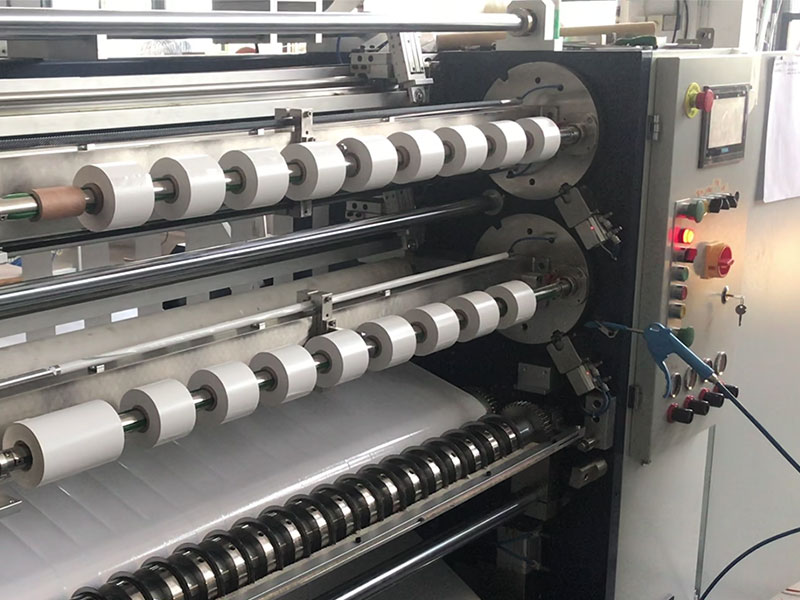
Key Point 3: Assess production efficiency and automation levels
Production efficiency determines the output per unit of equipment and directly affects labor costs and delivery times.
• Slitting speed: ranging from several tens of meters per minute to over 600 meters per minute. For general use, choose 150-300m/min; For large-scale production of BOPP adhesive, it is recommended to choose high-speed machines above 400 m/min.
• Automatic winding and rewinding: Does it have automatic cutting, automatic labeling, and automatic flipping and discharging functions? The fully automatic slitting machine reduces manual intervention time, allowing one person to operate 2-3 devices simultaneously.
• Automatic tool placement system: Traditional manual tool layout requires shutting down and manually moving the tool holder, taking 10-30 minutes; Automatic tool layout allows specification input via touchscreen, and the tool holder automatically moves to the set position, reducing specification change time to under one minute.
• Automatic waste edge handling: Can narrow-edge waste generated by slitting be automatically collected, blown, or wound for processing? This greatly affects production continuity and workshop cleanliness.
Selection advice: First, calculate your daily order batch quantity and the specification quantity per batch. For many batches and frequent specification changes, be sure to choose the automatic tool layout model; For small batches but large batches, emphasis can be placed on high-speed continuous operation capability.
Key Point 4: Pay attention to the stability of the tension control system
Tension control is the core technical challenge of slitting machines. If the tension on single sided adhesive is uneven during slitting, it may result in: uneven tightness during winding, misaligned end-face layers, stretching deformation, or even transfer or tearing of the adhesive layer.
An excellent tension control system should have:
• Unwinding section: Equipped with variable frequency motors or servo motors for active unwinding, combined with floating rollers or tension sensors for closed-loop PID control, ensuring constant tension from full to empty roll of the main roll.
• Rewinding section: Each rewinding shaft should be driven independently and controlled by adhesiver tension (tension gradually decreases as the diameter increases, avoiding tightness inside and looseness outside).
• Traction and slitting zone: Several guide rollers and S-type traction roller groups are installed to isolate tension interference between unwinding and rewinding.
Selection recommendation: Visit the equipment manufacturer's showroom to test the machine, run a roll of the adhesive you actually produce (especially thin and easy-stretch types), observe on site whether the end face of the finished roll is neat, and press the roll by hand to feel if the tension between layers is even. At the same time, ask about the controller brand—imported brands (such as Mitsubishi, Siemens) usually have better reliability than domestic low-end solutions.
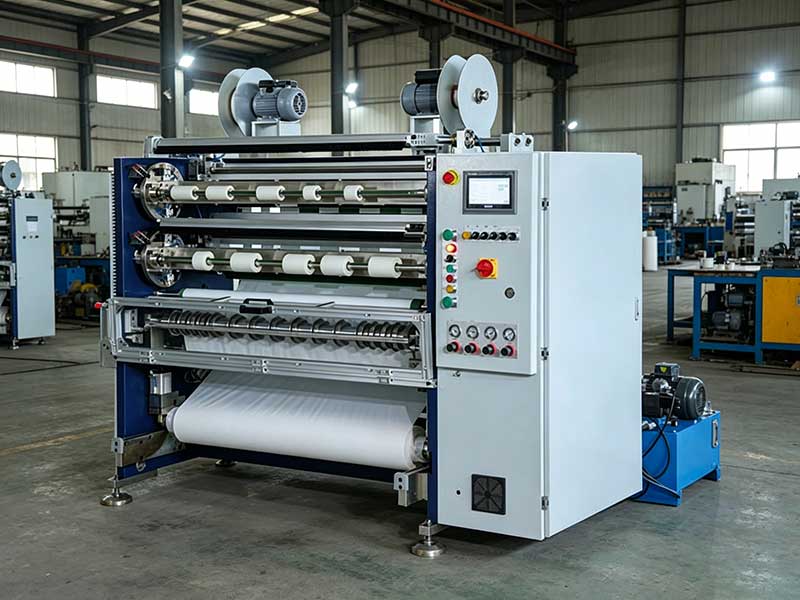
Key Point 5: Consider equipment stability, maintenance costs, and after-sales service
Slitting machines are long-term production equipment, and a single purchase often takes 5-10 years, so long-term operation stability and overall usage costs are very important.
• Core component brands: motors, frequency converters, touch screens, bearings, blade materials, etc., directly affect failure rates. Require manufacturers to provide a list of brands for major purchased parts.
• Body structure and materials: Has the frame undergone aging treatment and precision machining? Thinner wall panels may vibrate at high speeds, affecting accuracy. Heavy-duty cast iron or thickened steel plate welded structures are more reliable.
• Energy consumption: Compare the installed power and actual operating current of different models, and whether there is an energy-saving mode.
• Ease of replacing wear parts: How often should blades, rubber rollers, belts, etc. be replaced? Are accessory prices transparent?
• After-sales service: Does the manufacturer provide installation and commissioning, operational training, and fault response commitments (such as on-site delivery within 24 hours)? Is there a spare parts warehouse?
Selection advice: Don't just look at the bare metal price. Request customer cases of the same model from the manufacturer from the past two years, and randomly contact 2-3 users to inquire about actual fault frequency, repair response speed, and spare parts costs.
Summary
The selection of single sided rubber slitting machines requires balancing material properties, precision requirements, production efficiency, control levels, and long-term costs. It is recommended to review the following list before making a purchase:
1. The main types and characteristics of slitting adhesive (substrate, thickness, tackiness).
2. Minimum width and maximum diameter commonly processed.
3. Daily average capacity demand and batch specification change frequency.
4. Budget scope (including equipment price, installation and modification, training, and first-year spare parts).
5. Equipment placement site conditions (voltage, air source, space dimensions).
Finally, be sure to conduct on-site trial cutting at least two equipment manufacturers to compare the finished product results firsthand. A suitable single sided adhesive slitting machine can continuously save you scrap losses and improve customer satisfaction for years to come—this is the most worthwhile reward for choosing a model.
The following analysis covers three aspects: equipment hardware, material characteristics, and process parameters, hoping to provide you with a useful reference.
06. July, 2026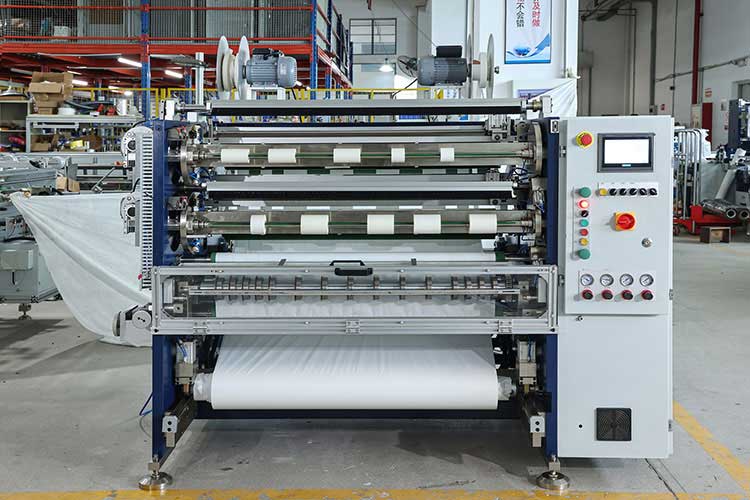
it is a specialized machine that precisely "breaks down wide-width tape rolls" into small finished rolls of narrow specifications to meet our requirements.
01. July, 2026Scientific preventive maintenance is the fundamental guarantee for extending equipment lifespan and stabilizing product pass rates.
23. June, 2026Uneven winding, edge burrs, and abnormal operating noises are the three major problems troubling frontline operators.
15. June, 2026Many people find it complicated for the first time, but once you master the core steps, you can get started smoothly in just three minutes.
08. June, 2026


 English
 Deutsch
 Français
 Español
 Português
 日本語
日本語 русский
 한국어
한국어 عربي
عربي ภาษาไทย
 Tiếng Việt
 Italiano