
Ribbon slitting is a key process in the production of thermal transfer ribbons, and its efficiency directly determines delivery capability and cost competitiveness. However, the ribbon substrate is PET film with a size of 4.5~10μm, which is easily stretched and wrinkled, and the slitting process is extremely sensitive to tension and precision. Many companies face the dilemma of "high nominal equipment speed but slow actual operation," fundamentally due to the intertwined effects of frequent belt breaks and downtime, prolonged specification changes, and unstable tension control. This paper proposes a practical efficiency improvement plan from three dimensions: downtime management, switching optimization, and tension upgrade.
1. Diagnosis of the root causes of efficiency loss
Before formulating a plan, it is necessary to clarify the true nature of efficiency losses. According to industry field data, among unplanned shutdowns of ribbon slitting machines, ribbon breakage accounts for as much as 60%, poor winding/unwinding accounts for 25%, and false alarms from electrical and sensor systems account for 15%. The average handling time for a single band break is 15~30 minutes. If it happens 4~5 times per day, just the downtime alone will consume 1.5~2.5 hours of effective working time.
Another hidden loss comes from changing specifications. Under the trend of multi-specification, small-batch orders, a single tool change and parameters adjustment on traditional slitting machines takes 25~45 minutes, covering five steps: disassembling and assembling the blade set, resetting tension parameters, replacing the shaft core, threading tape alignment, and trial cutting verification. Changing specifications 5~8 times per day is equivalent to losing 2~3 hours of effective production capacity per device.
A deeper problem is that many slitting machines still use open-loop magnetic powder braking control, with tension fluctuations reaching up to ±10%. Operators are forced to slow down to maintain basic mass—the equipment capacity is 300m/min, but in reality, it can only run 100~150m/min. The core logic of efficiency improvement is not to make equipment run faster, but to ensure that equipment is no longer forced to stop at high speeds.
2. Downtime Management: Minimize the belt break rate
Broken strips are the number one killer of efficiency, and treatment must be advanced simultaneously from three lines: cutting tools, correction, and static electricity.
Tool upgrades and standardization. Ordinary stainless steel blades wear out extremely quickly when slitting 4.5μm thin substrates; blunt blades turn "cutting" into "squeezing," and burrs and adhesions at the cut directly trigger tearing. The plan recommends switching to high-hardness tungsten carbide inserts, which can extend service life by three times. At the same time, a standard tool gap specification is set: overlap controlled at 0.01~0.03mm, lateral clearance at 0.02~0.05mm, and calibrated with feeler gauge before each shift. Where conditions permit, production lines can introduce automatic tool sharpening devices to grind the blade edge online, avoiding intermittent strip breakage caused by tool condition fluctuations.
Correction system response speeds up. During narrow belt slitting, the ribbon has very weak lateral rigidity; even slight disturbances can cause deviation, leading to edge lifts and collision guards triggering shutdown. Replacing traditional ultrasonic deviation correction sensors with high-precision infrared digital sensors increases response speed by 50%. Combined with active rubber rollers tightening the ribbon before and after slitting, it significantly reduces runout-induced deviation. For narrow strips with widths under 10mm, the unwinding tension should be reduced to 60%~70% of conventional broadbands to avoid excessive tension that could "thin" the ribbon and cause it to detach from the slot.
Static elimination and signal interference suppression. Electrostatic dust adsorption generated by high-speed slitting not only contaminates the edge edge and degrades the cut edge, but also interferes with the broken band detection sensor and causes false alarms. Install AC-type static elimination rods at the roller pass to ensure the equipment's grounding resistance is less than 4Ω. At the same time, the sensor signal line is replaced with twisted-pair shielded wire and grounded separately. The PLC program adds a 50ms delay confirmation logic to filter out false emergency stops caused by instantaneous interference.
3. Switch optimization: cut the specification change time in half
Specification change shutdowns do not directly generate scrap, but they represent the largest efficiency funnel in multi-variety order scenarios. The core idea is to shift from "on-board adjustment" to "offline pre-adjustment."
Modular tool sets and offline presetting stations. The slitting round blade, spacer gasket, and lower anvil roller are integrated into a quick-release "cutter box," with each cutter box corresponding to a fixed slitting width combination. During equipment operation, operators pre-assemble and lock the custom fixtures by pre-clicking the width combination of the next order. When changing specifications, simply remove the old cartridge and insert it into the new cartridge, then clamp with one button pneumatically. Tool change time can be reduced from an average of 20 minutes to under 3 minutes, while eliminating human positioning errors.
One-click access to the process recipe library. For ribbons of different widths, thicknesses, and substrate types, more than 20 parameters such as unwinding tension taper, rewinding pressure of the rollers, slitting speed, and acceleration/deceleration time are all different. After establishing the electronic recipe database, operators scan codes to access work orders, and the PLC automatically downloads all parameters to the frequency converter and tension controller, reducing the setting time from 8~12 minutes to within 10 seconds, and eliminating trial cutting scrap caused by input errors. On the winding side, the air-expanding shaft is synchronized with a self-centering chuck. The same shaft can be adapted to different tube inner diameters by switching the effective diameter of the airbag and reducing shaft centering time from 5~8 minutes to 1 minute.
Comprehensive calculations show that after implementing these three measures, downtime for a single specification change can be reduced from 25~45 minutes to under 10 minutes. For workshops with more than five daily changes, this means an additional 1.5~2 hours of effective production capacity per day.

4. Tension closed-loop: Releases the design speed of the equipment
The first two measures solve the problem of "stopping," while tension escalation addresses the problem of "slow to run." The speed ceiling for ribbon slitting is essentially determined by the precision controlled by tension.
Traditional open-loop torque motors or magnetic powder brakes respond slowly and fluctuate greatly; at high speeds, tension spikes directly break the substrate. The proposal suggests upgrading the unwinding side to a closed-loop vector frequency converter combined with floating roller tension feedback, enabling real-time PID adjustment and compressing tension fluctuations from ±10% to within ±0.5N. The rewinding side uses a taper tension algorithm—automatically lowering tension as the diameter increases, preventing inner layer compression deformation and causing "chrysanthemum core" wrinkles. During the start and stop phases, S-curve acceleration and deceleration control is introduced to prevent strip breakage caused by sudden tension changes.
For multi-variety mixed-line production, more than 20 sets of tension process parameters (classified by substrate type, width, thickness) are pre-stored and can be recalled with one click when switching orders, avoiding repeated trial adjustments by operators based on experience. After upgrading the closed-loop tension system, stable operating speed can usually increase by 30%~50%. Lines that previously could only run at 120m/min are expected to reach 180~200m/min while ensuring product yield.
5. Supporting Guarantees and Expected Outcomes
The effectiveness of these three solutions depends on two fundamental supports. First, institutionalize preventive maintenance. A daily inspection checklist has been developed, covering blade status, tension roller cleaning, electrostatic rod function, and air source pressure; Replace the polyurethane rubber ring of the winding pressure roller every 200 hours of operation to prevent slipping. Second, environmental control. The ribbon slitting workshop must be equipped with dust-free flooring, with temperature and humidity controlled between 20~25°C and RH 40%~60% to reduce dust adsorption and static electricity accumulation.
Based on data from comprehensive industry improvement cases, after a complete efficiency improvement plan is implemented, the expected outcomes are: unplanned downtime reduced by over 90%, finished product rate increased from about 93% to over 98%, and single-shift output increased by about 50%. It is important to emphasize that efficiency improvements in ribbon slitting do not involve a "single breakthrough"—the four lines of cutting tool, tension, correction, and order change are interdependent, and any shortcomings in any link will drag overall efficiency back to a bottleneck. The value of the solution does not lie in the advancement of any single technology, but in managing the four stages as a system, enabling the equipment to run each volume continuously and stably at high speed.
This article will break down the technical core of this function from four dimensions: signal detection, control logic, shutdown strategy, and precision calibration.
19. October, 2026
The value of the automatic correction function lies in incorporating this runaway variable into a precise closed loop, shifting slitting operations from "post-event selection" to "real-time self-heali
19. October, 2026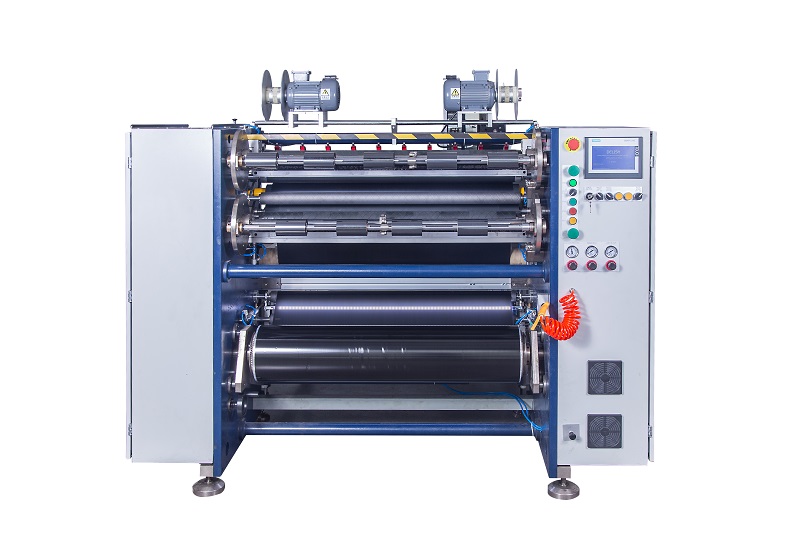
Choosing the right slitting machine is not just about buying a piece of equipment, but about establishing a production system that controls losses from the source.
17. October, 2026When tension is precisely controlled, the transfer quality, slitting yield, and production efficiency of the ribbon are fundamentally guaranteed.
17. October, 2026When a roll of perfectly slitted ribbon is loaded into the printer, smoothly moving along the tape and transferring clearly the print, the value of the slitting process quietly becomes realized.
17. October, 2026


 English
 Deutsch
 Français
 Español
 Português
 日本語
 русский
 한국어
 عربي
 ภาษาไทย
 Tiếng Việt
 Italiano